“And We have revealed to you, [O Muhammad], the Book in truth, confirming that which preceded it of the Scripture and as a criterion over it…” (Q 5:48).
The criterion means that the Qur’an is the Supreme Authority and adjudicator, dominant over all other Scriptures and Books. As such, no law, commandment or instruction contained in those Books is to be implemented unless it is proven to be sound and uncorrupted and confirmed by the Qur’anic texts. (Pillars of Īman (Creed) : Belief in the Scriptures p 48 @www.islamhouse.com)
Although I don’t fully subscribed to modern-day Salafi movement, I echo his position on this very important fundamental belief regarding how we consider previous scriptures. Like Br. Paul W. said “All I know for sure is that we can rely on the Quran. That has not been changed.”
Regarding text in Isaiah for example, we must rigorously examine if the information survived in it is really proven to be sound and uncorrupted, and most importantly does not contradict fundamental faith as revealed in the Qur’an.
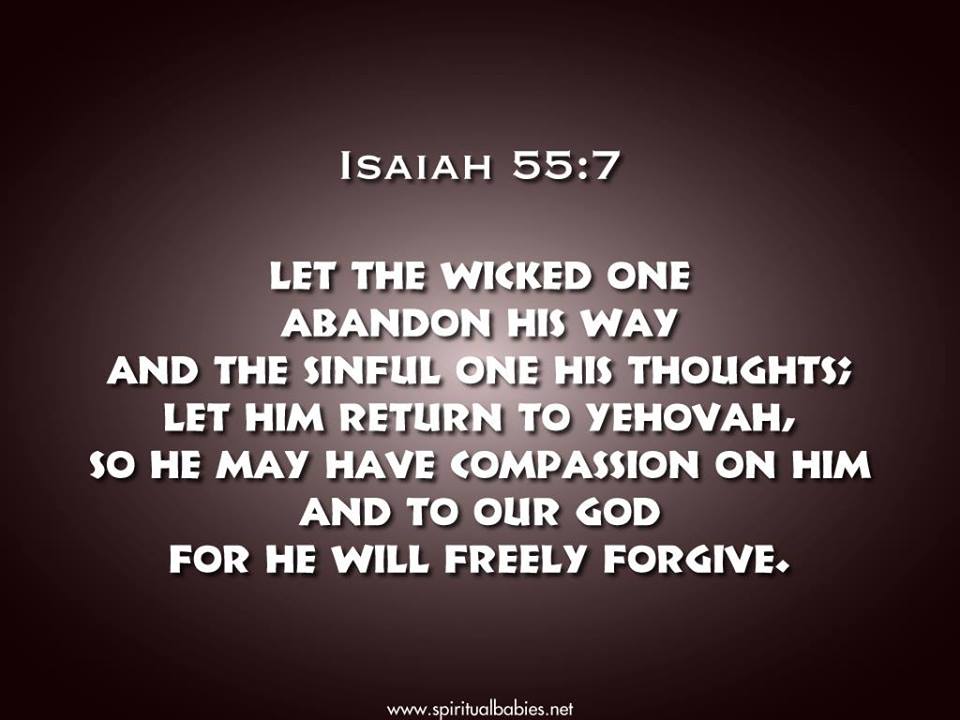
Regarding the text in the post, although it does not contradict the fundamental faith as revealed in the Qur’an it is not by Isaiah the prophet but an unknow later Jewish scribe. The Bible can be very tricky!
If its authenticity back to prophet Isaiah can not be verified, then it is not sound.
It is like a ‘hadîth’ which is composed of matn (text) but no isnad (chain of narration). Without isnad anyone can claim anything saying that it is coming from the authority.
We can never be sure whether the ‘text’ is not mixed with falsehood without the proper isnad and its verification thus by using hadîth methodology this must be rejected although there’s no contradiction with the fundamental faith as revealed in the Qur’an.
You have to accept Isaiah chapter 53 for Isaiah 55:7 to be possible. Without God’s grace and His substitutionary atonement for you, there is no real power to truly repent and turn to God.
Qur’an Surah 5:48 must also be seen in light of 5:47, and it shows that the Injeel was not corrupted at the time of Muhammad.
No one can demand or guarantee 100 % certainty on anything. We can reasonably say that we have 99.9 % of the original NT documents, based on all the evidence and taking into account the textual variants. The main textual variants issues are not in the apostle Paul’s writings, but Mark 16:9-20, I John 5:7; and John 7:53-8:11.
The originals are within the textual tradition available to us. We have to take the textual variants on a case by case study.
There are some textual variants, but nothing that affects any major doctrine that is not in other passages of Scripture.
When the older papyrii were found (120 AD – 250 AD), they confirmed the great Uncial texts of Codex Siniaticus and Codex Vaticanus of 300-350 AD.
For example, Mark 16:9-20 is not in the oldest manuscripts, but all of the doctrinal and historical truths are repeated in many other places in the other gospels, Acts, and epistles. The Empty Tomb is solidly attested for in Mark 16:1-8, and proves the resurrection of Christ from the dead. Eyewitness appearances of Jesus as risen from the dead and the ascension to heaven are in other accounts that are solid.
Irenaeus around 180 AD quoted Mark 16:19 – “Jesus was taken up to heaven and sat down at the right hand of God”. It seems that there was another longer ending after verse 8, but we have to wait and see if there is some more archeological evidence that comes out.
1 John 5:7, the comma Johannian – Ignatius defended the Deity of Christ in 110 AD without it; Polycarp (155 AD), Justin (165 AD), Tertullian (180-220 AD), Irenaeus (180-202 AD), Cyprian (250 AD), Origen (250 AD), and Athanasius (296-373 AD) defended the Deity of Christ and the Trinity without the comma Johannian.
John 7:53-8:11 – this story is actually attested to by Papias, in a general way, in an ancient fragment. The fact that this oral tradition was in Luke and other places in the canon shows that it was around, but does not belong in the place that John has it in later manuscripts.
I understand you are a preacher/missionary of some sort. Seen as you are discussing the Bible and corruption of the text can I put the following to you, I’ve put this to Dr James White amongst others and yet have had no real answer:
Have you ever stopped to think about all those Christians prior to the 19th century discovery of Codex Sinaiticus who used to believe the last 12 verses of Mark were inspired by God and part of the Bible (they had similar beliefs about John 7:53-8:11 and that version of Luke 23:34). NOW you and other modern day Christians will claim those Christians of the past believed in forgeries/errors.
You have no guaranty that this will not happen to you in your life time (i.e. a new MSS discovery is made and a passage is denounced as an unauthorised addition).
//You have to accept Isaiah chapter 53 for Isaiah 55:7 to be possible. Without God’s grace and His substitutionary atonement for you, there is no real power to truly repent and turn to God.//
Muslim are not obliged to accept anything outside the Qur’an and authentic hadiths. Nothing in the Qur’an which says god shall commit suicide or kill a human to forgive sins..and I will argue not in Isa 53 as well. Thats just such an utter abhorrence in the sight of God,
//Surah 18:27 There is no changing of the words of Allah.//
Amen.
Greek and other human writings by Paul and the unknown scribes clearly are not the words of Allah Subhanahu Wata’ala
 Blogging Theology
Salam.
This will work for christians who consider Isaiah part of the Bible.
But I have to ask Paul, even if it’s not written by Isaiah is it possible for us to believe that it is still part of revelation but mixed up?
LikeLiked by 1 person
Good question. I am not qualified to answer that. All I know for sure is that we can rely on the Quran. That has not been changed.
LikeLike
Ok, thanks for responding, JazakAllahu Khair.
LikeLiked by 1 person
maybe someone else can help answer your question..
LikeLiked by 1 person
Salam Muslimtheology,
If I may offer one of Sunni position on your question that “All previous books have been superseded منسوخ by the Qur’an”
Allah said:
“And We have revealed to you, [O Muhammad], the Book in truth, confirming that which preceded it of the Scripture and as a criterion over it…” (Q 5:48).
Prominent Salafi scholar As-Syaikh Muhammad ibn Salih Al-Uthaymeen in his The Explanation of the Fundamentals of Islamic Belief explains:
Although I don’t fully subscribed to modern-day Salafi movement, I echo his position on this very important fundamental belief regarding how we consider previous scriptures. Like Br. Paul W. said “All I know for sure is that we can rely on the Quran. That has not been changed.”
Regarding text in Isaiah for example, we must rigorously examine if the information survived in it is really proven to be sound and uncorrupted, and most importantly does not contradict fundamental faith as revealed in the Qur’an.
LikeLiked by 2 people
very helpful Eric, thank you
Regarding the text in the post, although it does not contradict the fundamental faith as revealed in the Qur’an it is not by Isaiah the prophet but an unknow later Jewish scribe. The Bible can be very tricky!
LikeLike
If its authenticity back to prophet Isaiah can not be verified, then it is not sound.
It is like a ‘hadîth’ which is composed of matn (text) but no isnad (chain of narration). Without isnad anyone can claim anything saying that it is coming from the authority.
We can never be sure whether the ‘text’ is not mixed with falsehood without the proper isnad and its verification thus by using hadîth methodology this must be rejected although there’s no contradiction with the fundamental faith as revealed in the Qur’an.
LikeLiked by 1 person
Eric if you have the time could you put together a brief article about this?
LikeLike
It is a good idea, InshaAllah I’ll write more on this.
LikeLiked by 1 person
But is Isaiah even a Prophet in Islamic Tradition.
LikeLike
You have to accept Isaiah chapter 53 for Isaiah 55:7 to be possible. Without God’s grace and His substitutionary atonement for you, there is no real power to truly repent and turn to God.
Qur’an Surah 5:48 must also be seen in light of 5:47, and it shows that the Injeel was not corrupted at the time of Muhammad.
LikeLike
Surah 18:27
There is no changing of the words of Allah.
the previous scriptures (OT and NT) cannot have been corrupted.
http://www.aomin.org/aoblog/index.php/2015/10/29/of-no-mans-lands-and-ecumenism-and-sanctification-and-textual-families/
LikeLike
Ken can you guarantee that 100% of the words written by Paul are unchanged – just as he wrote them?
LikeLike
No one can demand or guarantee 100 % certainty on anything. We can reasonably say that we have 99.9 % of the original NT documents, based on all the evidence and taking into account the textual variants. The main textual variants issues are not in the apostle Paul’s writings, but Mark 16:9-20, I John 5:7; and John 7:53-8:11.
The originals are within the textual tradition available to us. We have to take the textual variants on a case by case study.
There are some textual variants, but nothing that affects any major doctrine that is not in other passages of Scripture.
When the older papyrii were found (120 AD – 250 AD), they confirmed the great Uncial texts of Codex Siniaticus and Codex Vaticanus of 300-350 AD.
For example, Mark 16:9-20 is not in the oldest manuscripts, but all of the doctrinal and historical truths are repeated in many other places in the other gospels, Acts, and epistles. The Empty Tomb is solidly attested for in Mark 16:1-8, and proves the resurrection of Christ from the dead. Eyewitness appearances of Jesus as risen from the dead and the ascension to heaven are in other accounts that are solid.
Irenaeus around 180 AD quoted Mark 16:19 – “Jesus was taken up to heaven and sat down at the right hand of God”. It seems that there was another longer ending after verse 8, but we have to wait and see if there is some more archeological evidence that comes out.
1 John 5:7, the comma Johannian – Ignatius defended the Deity of Christ in 110 AD without it; Polycarp (155 AD), Justin (165 AD), Tertullian (180-220 AD), Irenaeus (180-202 AD), Cyprian (250 AD), Origen (250 AD), and Athanasius (296-373 AD) defended the Deity of Christ and the Trinity without the comma Johannian.
John 7:53-8:11 – this story is actually attested to by Papias, in a general way, in an ancient fragment. The fact that this oral tradition was in Luke and other places in the canon shows that it was around, but does not belong in the place that John has it in later manuscripts.
LikeLike
But Ken you said
“the previous scriptures (OT and NT) cannot have been corrupted”
Cannot! Then you say you cannot guarantee 100% certainty on anything!
You are having your cake and eating it Ken.
LikeLike
Acknowledging some .o1 percent of uncertainty about passages that do not affect any major doctrine is not trying to having my cake and eating it.
LikeLike
@Ken
I understand you are a preacher/missionary of some sort. Seen as you are discussing the Bible and corruption of the text can I put the following to you, I’ve put this to Dr James White amongst others and yet have had no real answer:
Have you ever stopped to think about all those Christians prior to the 19th century discovery of Codex Sinaiticus who used to believe the last 12 verses of Mark were inspired by God and part of the Bible (they had similar beliefs about John 7:53-8:11 and that version of Luke 23:34). NOW you and other modern day Christians will claim those Christians of the past believed in forgeries/errors.
You have no guaranty that this will not happen to you in your life time (i.e. a new MSS discovery is made and a passage is denounced as an unauthorised addition).
LikeLiked by 1 person
//You have to accept Isaiah chapter 53 for Isaiah 55:7 to be possible. Without God’s grace and His substitutionary atonement for you, there is no real power to truly repent and turn to God.//
Muslim are not obliged to accept anything outside the Qur’an and authentic hadiths. Nothing in the Qur’an which says god shall commit suicide or kill a human to forgive sins..and I will argue not in Isa 53 as well. Thats just such an utter abhorrence in the sight of God,
//Surah 18:27 There is no changing of the words of Allah.//
Amen.
Greek and other human writings by Paul and the unknown scribes clearly are not the words of Allah Subhanahu Wata’ala
LikeLike