12 And on the morrow, when they were come from Bethany, he was hungry:
13 And seeing a fig tree afar off having leaves, he came, if haply he might find any thing thereon: and when he came to it, he found nothing but leaves; for the time of figs was not yet.
14 And Jesus answered and said unto it, No man eat fruit of thee hereafter for ever. And his disciples heard it.
Nonsense. Some of the most highly respected NT scholars argue that the NT is an accurate collection of eyewitness accounts, or accounts given by people who had close association with witnesses.
That aside, you forget – one o your muslim commenters is quoting the bible – is it corrupt or isn’t it?
only one of them i guess. what i am trying to find out is if it possible that eyewitnesses can describe the same event using the same words and same sequence.
scholars say that matthew has stolen 90 % of mark.
This is an extract from my book Jesus as Western Scholars See Him: A Resource for Muslim Dawah Carriers
The Christology of the Gospels
On a first reading of the gospels of Matthew, Mark and Luke, it is tempting to take these
stories at face value: here are ancient texts that tell us what Jesus said and did. Their
reliability and facticity is usually assumed without question. And this way of reading of the
gospels has been ubiquitous in the Christian churches for much of the last 2000 years.
Today, however, such a reading of the gospels is no longer possible. To start with the most
obvious observation: there are four gospels, and each has a different picture of Jesus and
his teaching. The fourth gospel, that of St John, presents the reader with a substantially
different account of the teaching of Jesus, a conflicting chronology of his life (for example
the date of Jesus’ crucifixion differs) and perhaps most significantly, John presents a high
christology that is radically different from the synoptics. Thus NT scholars have long
concluded that the gospels tell us as much about the views of their authors as they do
about the events and words of Jesus they allegedly narrate.
Christopher M Tuckett (Professor of New Testament Studies in the University of Oxford) in
his critically acclaimed work Christology and the New Testament: Jesus and His Earliest
Followers, (Edinburgh University Press 2001) comments:
‘The picture of Jesus in John is in many respects very different from the picture in the other
three, so-called ‘synoptic’, Gospels. Furthermore, most would agree that, in general terms,
the synoptic picture is more likely to reflect the realities of Jesus‘ own time, and the
Johannine account represents an (at times) extensive rewriting of the Jesus tradition by a
later Christian profoundly influenced by his own ideas and circumstances. However, it is
now recognised that what applies to the Fourth Gospel applies equally to all the Gospel:
the synoptic Gospels, quite as much as John, have been influenced by the ideas and the
circumstances of their authors. Thus in reading all the Gospels, we have to be aware of
the fact that we reading accounts of Jesus‘ life as mediated by later Christians and hence
we may learn much, if not more, about the latter as about Jesus himself in studying the
Gospel texts.’
“Testimony [in the NT] should be treated as reliable until proved otherwise. “First, trust the word of others, then doubt if there are good reasons for doing so.”
Acclaimed evangelical scholar Richard Bauckham in his recent book on the gospels Jesus
and the Eyewitnesses: The Gospels as Eyewitness Testimony (2006, Wm. B. Eerdmans
Publishing Co) argues that the fourth gospel stems from an eyewitness to the ministry of
Jesus, namely, the disciple John. At the same time, however, Bauckham also
acknowledges that,
“All scholars, whatever their views of the redactional work of the Synoptic Evangelists and of the historical reliability of the Gospel of John, agree that the latter presents a much more thoroughly and extensively interpreted version of the story of Jesus.”
(p. 410.)
Christianity Today is America’s top Evangelical magazine. Professor Richard Bauckham won the prestigious Christianity Today Book Award in biblical studies for his book Jesus and the Eyewitnesses: The Gospels as Eyewitness Testimony.
Bauckham (Professor of New Testament Studies in the University of St Andrews, Scotland) has also authored a little known (at least outside of scholarly circles) book entitled God Crucified: Monotheism and Christology in the New Testament. He argues that the first Christians included Jesus in the unique identity of the God of Israel in a way that was compatible with Jewish monotheism. In other words, Bauckham claims the early Church redefined Jewish monotheism in such a way as to include Jesus within its conception of God.
One of the weaknesses of his argument is his use of texts that he himself clearly believes are fictionalised accounts of Jesus’ teaching. Consider these statements taken from his book God Crucified:
‘The Gospel of John places on the lips of Jesus during his ministry another of the characteristically Deutero-Isaianic declarations of unique divine identity. The Johannine choice is the concise statement ‘I am he,’ usually translated in the Septuagint Greek as ego eimi (‘I am’), the form in which it appears in John’s Gospel.’ (page 55)
‘We observed earlier [page 55] how John places Deutero-Isaiah’s great monotheistic
self-declaration of God – ‘I am he’ – on the lips of Jesus in the series of seven absolute ‘I am’ sayings.’ (page 63)
If the author of the Fourth Gospel knowingly placed the I am statements in ‘on the lips of
Jesus’, then Jesus obviously by definition he did not say them, and John has invented
sayings which countless generations of Christians have nevertheless taken as the actual
words of Jesus.
But if John’s portrayal of Jesus represents a ‘highly interpreted’ and partly fabricated
account of his life and teaching why should we believe what it says? Readers of the
gospel may wish to know the unaltered, original words and teaching of Jesus rather than a
“highly interpreted” later account.
Bauckham’s views are based on a detailed analysis of the gospels’ genre and
a comparison of the synoptic gospels and John. His views on the historicity of Jesus’
sayings in John are widely shared by other scholars (outside of fundamentalist seminaries)
Bauckham argues that the fourth gospel [John] stems from an eyewitness to the ministry
of Jesus, namely, the disciple John. At the same time, however, Bauckham also
acknowledges the significant differences between the fourth gospel and the Synoptics and
argues that John is a more reflective and a highly interpreted account of the life and
ministry of Jesus. Regarding the four gospels in general, he concludes:
In all four Gospels we have the history of Jesus only in the form of testimony, the
testimony of involved participants who responded in faith to the disclosure of God in these
events. In testimony fact and interpretation are inextricable; in this testimony empirical
sight and spiritual perception are inseparable.
Richard Bauckham, Jesus and the Eyewitnesses: The Gospels as Eyewitness Testimony,
2006, Wm. B. Eerdmans Publishing Co., p. 411.
As we have already seem above, regarding the gospel of John Bauckham says:
All scholars, whatever their views of the redactional work of the Synoptic Evangelists and
of the historical reliability of the Gospel of John, agree that the latter presents a much more
thoroughly and extensively interpreted version of the story of Jesus.
(Ibid. p. 410.)
According to Bauckham, the eyewitness author of the gospel of John did not just simply
rehash mere eyewitness reports, but he also weaved into his story of Jesus his highly
reflective interpretations and understanding of the events:
“… we can also apply the contrast between Mark (or the Synoptics in general) and John
more widely. The greater selectivity of events recorded, the more continuous narrative with
its more strongly delineated plot, the lengthy discourses and debates – all these distinctive
features of the Gospel of John, as compared with the Synoptics, are what make possible
the much fuller development of the author’s own interpretation of Jesus and his story, just
as comparable features of the works of the Greco-Roman historians enable the expression
of their own understanding of the history, making their works more than mere reports of
what the eyewitnesses said. But in the case of the Gospel of John these characteristics
are linked with its claim to be entirely the testimony of an author who was himself an
eyewitness. In this case, the whole historiographic process of eyewitness observation and
participation, interrogation of other eyewitnesses, arrangement and narrativization in the
formation of an integrated and rhetorically persuasive work – all this was the work of an
eyewitness, whose interpretation was, of course, in play at every level of the process, but
in what one might think of as a cumulative manner, such that the finished Gospel has a
high degree of highly reflective interpretation. The eyewitness claim justifies [really?] this degree of interpretation for a context in which the direct reports of the eyewitnesses were the most highly valued forms of testimony to Jesus. In the case of the other Gospels it was important that the form of the eyewitness testimonies was preserved in the Gospels. The more reflective interpretive Gospel of John does not, by contrast, assimilate the
eyewitness reports beyond recognition into its own elaboration of the story, but is, as it
stands, the way one eyewitness understood what he and others had seen. The author’s
eyewitness status authorizes the interpretation. Thus, whereas scholars have often
supposed that this Gospel could not have been written by an eyewitness because of its
high degree of interpretation of the events and the words of Jesus, by contrast with the
Synoptics, in fact the high degree of interpretation is appropriate precisely because this is
the only one of the canonical Gospels that claims eyewitness authorship.”
(Ibid. pp. 410 – 411.)
Note that Bauckham does not deny the “highly reflective interpretational” status of the
gospel of John. He only justifies it by arguing that the author was an eyewitness.
In light of the above, even if we are to accept the fourth gospel as a product of an
eyewitness (and it should be noted that most experts disagree with Bauckham), it does not
mean that we can simply read off from its surface the words attributed to Jesus as if Jesus
literally uttered them in during historical ministry.
“one o your muslim commenters is quoting the bible – is it corrupt or isn’t it?”
Saheeh Bukhari
Volume 9, Book 93, Number 614:
‘Abdullah bin ‘Abbaas said, “O the group of Muslims! How can you ask the people of the Scriptures about anything while your Book which Allah has revealed to your Prophet contains the most recent news from Allah and is pure and not distorted? Allah has told you that the people of the Scriptures have changed some of Allah’s Books and distorted it and wrote something with their own hands and said, ‘This is from Allah, so as to have a minor gain for it. Won’t the knowledge that has come to you stop you from asking them? No, by Allah, we have never seen a man from them asking you about that (the Book Al-Qur’an ) which has been revealed to you.
An impressive selection of mined quotes notwithstanding, all of this is irrelevant. The muslim position is that the quran “corrects” the jews and christians.
Yet muslims seem reliant on mainly skeptical iireligious scholars to make the case that allah does not in the quran. Why do atheists know more about the bible than allah?
I have cited conservative evangelical scholars like Richard Bauckham who you cited in your defence! I can quote many more if you wish. They reject your naive view that John simply quotes the words of Jesus. He does not – they are highly interpreted, that us to say to a considerable extent they are fictionalised words attributed to Jesus.
Regarding the Islamic claim of textual corruption of the scriptures by the People of the Book see the massive evidence here:
And you are avoiding the problem I’ve raised – it is skeptical scholars (including atheists and agnostics) who provide muslims with studied material to question christian beliefs. There are no muslim scriptures, and there is absolutely nothing in the quran that details those parts of he bible that are supposedly corrupt.
WHy doesn’t allah know the bible enough to reveal which specific verses, chapters and books are corrupt? WHy does he need disbelievers to reveal that?
“And you are avoiding the problem I’ve raised – it is skeptical scholars (including atheists and agnostics) who provide muslims with studied material to question christian beliefs.”
Not so. If you look over the posts on this blog I often cite Christian scholars in addition to top experts like Bart Ehrman. I have quoted your own scholars to prove my point. Would you like some more? I can happily copy and paste from my book all day 🙂
Your other point is just silly: ‘why doesn’t God know the Bible well enough’ lol
The Quran does not provide a detailed commentary on the Bible’s textual corruption it is true. That is not its purpose. But biblical scholarship has uncovered much corruption and error in the texts. You seem to be very uncomfortable with this fact.
Did you look at the mass of Islamic evidence in the link I posted? Methinks you did not bother.
Quote some specific verses from the quran and sunnah that state exactly which verses, chapters and books of the bible are corrupted. If you can’t, that proves my point.
No – my link is an invitation for you to be better educated in Islamic teaching. A invitation you apparently rejected.
I have already said that the Quran does not provide a detailed exegetical commentary on the Bible’s textual corruption. I have already said that was not its purpose as God’s general address to mankind about the purpose of life, heaven and hell etc.
If you are unhappy about this you are displeased with your Creator. I cant help you any further.
Well that renders the quran far less credible. This post claims that allah even knows when a leaf falls, yet he does not know which verses in the bible are corrupted.
The NT goes into minute and specific detail about how the OT should be interpreted, yet teh quran does not even quote a single verse from the bible that is corrupted despite the claim that the quran “corrects” previous scriptures. IT just does not.
Surely it is more important for allah to have told us which specific parts of the bible are false rather than an idle boast that he knows when a leaf falls?
Paul,
Klng makes a good point; how come Allah doesn’t know what liberal and agnostic scholars know?
And remember, you even admitted Islamic scholar Abdel Haleem told you the Qur’an does not say that the Bible was corrupted.
“According to Paul Williams, world-renowned Islamic scholar Abdel Haleem confirmed for him in a phone conversation one of the two claims that Christians often make regarding the Bible. In the view of Professor Haleem, the Qur’an does NOT teach that the Bible was corrupted. Instead, it teaches that the Bible has been misinterpreted. Prof. Haleem’s statements in this connection, as PW says, “put Muslim apologist Bassam Zawadi (who has argued many times for the view that the Quran teaches textual corruption) in the wrong.” This, as Paul Williams also says, serves to “vindicate the oft-stated views of Sam Shamoun and David Wood.”
(Summary by Anthony Rogers)
This was at your old site, but you took it down.
All you did is call it “silliness”.
What is “Hod” ?
Is your book – Jesus as Western Scholars See Him: A Resource for Muslim Dawah Carriers
on Amazon?
Bauckham’s quote:
” . . . a much more
thoroughly and extensively interpreted version of the story of Jesus.” (p. 410)
means compared to the Synoptics (see sentence right before that, that you leave out on p. 410)
Conservative believing scholars would say that John 16:12-13 could be pointing to that –
“I have much more to reveal to you; but you cannot bear it now” (John 16:12)
Through the Holy Spirit, Jesus reveals more later and John wrote it down.
And John 16:13, with 14:26, points to “all things” and “all the truth” and “bring to your remembrance all that I have taught you”
So, the “more thoroughly and extensively interpreted version . . . ” is, according to John 14:26, and John 16:12-13, revelation from God, of the meaning of Jesus’ life and ministry and true and God-breathed.
Quran says the bible qot corrupted as long as you use the quranic terminlongy . I think Richard wrote an article about this topic, and you may read it with comments.
No; it affirms the Bible of Muhammad’s time – 10:94; 5:47; 68
It accuses a party of the Jews of changing the meaning, after hearing the true Scripture, then writing new material and claiming it was from God. (2:75, 78-79) verse 78 says they are illiterate, unlearned, that do NOT know the Scripture and just hearing things. (which is what it honestly seems like Muhammad is doing, just hearing things and making his own Scripture).
and 3:78-79 is about distorting the meaning of Scripture, not about changing the written text at all.
But Allah of the Qur’an does not know, since He affirmed all of the Text (متن ) of the previous Scriptures. And he didn’t know the doctrine of the Trinity (5:116; 5:72-78; 112; 19:88-92; 6:101), and denied established history too. (4:157)
Zawadi’s points are refuted by the context of 2:75-79 and 3:78-79 and Dr. White and Gordon Nickel’s book, A Gentle Answer, and John Gilchrist, and many others.
The Bible is notAl Injeelu Isa -Al Masih of the Qur’an. The goodnews of Isa -Al Masih is notthe Epistles of Paul or Peter or Revelation or the book of Acts. As is accepted by pretty much all of scholarship by now, Prophet Musa (p) and Isa Al Masih (p) most definitely had little to do with the current “OT” or “NT”.Those man-made writings was of uncertain origin that, at various points in time, ended up mistakenly thought of as scripture from God.
The Qur’an chargesagainst the scripture in the possession of those who DISTORTED IT (like the greek NT and all greek materials from unknown authorship) ,then claim it as the original words of God.
“Do you really hope that they will believe for you even though a group of from them used to hear the words of God then CORRUPTED it (يُحَرِّفُونَهُ) after understanding it, while they were knowing?” (Qur’an 2:75)
The Qur’an is clear that there were people who wrote the book with their own hand then claim that “this is from God”.Thats why we muslims do not believe OT and NTas Words of God
“So woe to those who write the book with their own hands and say, ‘This is from God’, so that they may trade it for a small gain, woe to them for what they write with their hands, and woe to them for what they earn!” (Qur’an 2:79)
The problem with all that is that you are taking something that came 600 years later and using to interpret the Gospel and NT that was already established and existed by 96 AD. All the NT books were written from 45-96 AD; and most of them are documented as God-breathed, inspired, “canon”, & known by Irenaeus and Tertullian in 180-200 AD. They just don’t mention some of the smaller ones, like 2 and 3 John. they were already God-breathed inspired books and Origen lists all 27 as that around 250 AD and Athanasius in 367 AD. All of this is long long before the man-made Qur’an made up by Muhammad, trying to claim line of prophesy and monotheism as a “third” book of revelation. They were all “the faith” of the Gospel of Jesus Christ, Injeel Isa Al Masih long before Qur’an. And Surah 2:75-78 is only about hearing it wrong and corrupting the meaning. 2:79 describes what Muhammad did – from hearsay, and unlettered / uneducated / illiterate – hears stuff and makes up new religion. 2:79 is not about NT, since it was already God-breathed long before Qur’an – 2 Timothy 3:16. (AD 67)
The Qur’an is the last of series of revelation from God. It is the continuation from earlier prophetic revelation. It is fully in sync with earlier teaching. While you believe in bogus set of books which was not even written in the language of Isa Al Masih. You follow the greek, roman tradition. It is the breakaway of the semitic revelation with strange doctrines such as trinity, human sacrifice etc.
at the time of Qur’an (613-632 AD) he says “go ask the people of the book” Surah 10:94. and “let the people of the gospel judge by God has revealed therein” ( Surah 5:47) Since the people of the book already established their books (66 – 39 OT, 27 NT), then the Qur’an does not claim that Christians had corrupted the true Scriptures.
The Injil of Jesus is not the book of NT. It was the revelation given to prophet Jesus, not the collection of anonymous writing nor the writings of Paul who were never met nor was the disciple of prophet Jesus (peace be upon him).
All these points have been discussed thoroughly in the article of Richard.
These repetitive points have nothing to do with the fact that Quran refers to the texual corruption done by the people of the scripture.
“The Injil of Jesus is not the book of NT. It was the revelation given to prophet Jesus, not the collection of anonymous writing nor the writings of Paul who were never met nor was the disciple of prophet Jesus (peace be upon him).”
WHere is the Injil and what exactly does allah tell us is in it? That aside, where in the quran does allah reveal the exact verses, chapters and books that are corrupted in the NT?
seems that would be so important, that you would need to write a major article on it, and post it; and documenting that you misunderstood him, with his correction of your misunderstanding.
But, the fact that you did not write a new post, with evidence that you misunderstood Abdel Haleem, given your powerful admission before (even vindicating Sam Shamoun and David Wood, and then deleting that old website,) is telling.
Therefore woe be unto those who write the Book with their hands and then say, “This is from Allah,” that they may purchase a small gain therewith. Woe unto them for that their hands have written, and woe unto them for that they earn thereby.
Here we clearly see that Allah is warning those (Jews) who wrote the scripture from their own selves and then claimed that it was from God. A clear charge of TEXTUAL corruption. The verse is clear is clearly stating that whatever the Jews wrote, they claimed it was from God.
Some Christians say that the Qur’an is only talking about a specific group of people and that else where in the Qur’an it speaks about the People of the Book positively…
Zawadi is not very credible on this verse, because he left the context of Surah 2:75 – “a party of them” = a specific group; and he left out verse 78, which tells us important information that affects how we interpret verse 79.
I am the one sticking to context.
Man ! The corruption in your bible is crystal clear in Quran . Yes there is distortions of the meaning AND the texual corruption .
Not to mention the understaing of Sahabah, the earliest commentators in Quran such as Ibn Sumliman , Maurdi , and Altabri
. , not to mention the canonical bible that you have today is another issue according to Quran.
2:75-79 and 3:79 are about distorting the meaning and writing other writings based on falsehood, hearsay, imagination, and from illiterate ones who don’t know the Scriptures.
Looking closely at Jesus’s comments on salvation, forgiveness, justification, the Law, God, etc suggests a set of teachings quite different to Paul’s and the standard Christian view today.
NT scholarship long ago uncovered this fact (cf the work of Johannes Weiss) and this is readily acknowledged by more liberal scholars today (eg James Barr).
A famous example would be the sacrifice-free forgiveness of sins taught by Jesus in the Lord’s Prayer. This can’t be just ignored.
– on our justification before God Jesus states unequivocally that ‘humility’ justifies a sinner in Luke 18 (cf Paul in Romans);
– obedience of the Jewish Law is *central* to discipleship in the Kingdom of God in Matthew 5:17-20, (cf Paul);
– how do we enter eternal life? by obeying the commandments says Jesus in Matt 19:17, (something Paul would never say);
– that salvation itself had come to Zacchaeus (by metanoia) was pronounced by Jesus in Luke 19 (but only available after the death & resurrection according to Paul);
– John the Baptist, revered as a great prophet in Islam, appeared proclaiming a baptism of repentance for the forgiveness of sins in Mark 1. People were baptised in the Jordan – thus their sins were forgiven;
– Jesus encouraged direct access to God the Father, (but Paul and later Christians introduced an intermediary between God and the believer);
There are numerous other examples I could recount. These sayings constitute the gospel *of* Jesus. Paul and later Christians preached a gospel *about* Jesus. The Proclaimer had become the one proclaimed. Jesus preached the Kingdom of God and it was the church that came.
The Quran acknowledges that the gospel of Jesus is to be found in the existing gospels but is not coterminous with it. Christians are called by God in his final Testament to mankind to judge what they believe by the gospel *of* Jesus, and this teaching is confirmed by the Quran. The Quran also corrects the mis-interpretations by Christians who wrongly believe Jesus is God. Jesus bears witness in the Quran that he is just a man.
Clearly the four gospels are not the Injil. They make claims (eg about the crucifixion) that God has made clear are quite unhistorical. The Quran suggests that the ‘Gospel’ (Injil) is something given to Jesus by God (surah 5:46). So it is evident that in the Qur’an the divine Gospel was one revealed to Jesus and not books written about Jesus.
A concluding quote from Montgomery Watt (who was Professor in Arabic and Islamic studies at the University of Edinburgh, and one of the foremost non-Muslim interpreters of Islam in the West):
“While it is stated that Jesus received from God a scripture called the Gospel (or Evangel – Injil), there is nothing to suggest that this was any more like our actual gospels in the New Testament than the tawrat received by Moses was like the actual Pentateuch. Indeed Muslims usually deny that our actual gospels are the book received by Jesus, since that consisted entirely of revelations from God and not of historical statements about Jesus.”
[William Montgomery Watt, Muslim-Christian Encounters. Perceptions And Misperceptions, Routledge, 1991, p. 24
I also refer you to the interesting discussion about the gospels/Injil in The Study Quran, surah 3: 3-4.
“Man ! The corruption in your bible is crystal clear in Quran . Yes there is distortions of the meaning AND the texual corruption .
Not to mention the understaing of Sahabah, the earliest commentators in Quran such as Ibn Sumliman , Maurdi , and Altabri
. , not to mention the canonical bible that you have today is another issue according to Quran.”
Here is a very simple question – please show us the verses in the quran that state with absolute clarity, which verses in the NT have been corrupted.
WHy does allah need atheistic and skeptical scholars to explain his eternal holy book?
SAHIH INTERNATIONAL
Do you covet [the hope, O believers], that they would believe for you while a party of them used to hear the words of Allah and then distort the Torah after they had understood it while they were knowing?
I looked at his comments at 2:79 and he never even addressed 2:75 or 2:78, which are in the context; after that I scrolled through the whole article and there is nothing in their about the immediate context. He jumps to 3:113-114 and 3:199; and the rest are quotes by scholars and a few Hadith, but totally avoided 2:75 and 2:78, both important to immediate context.
King: “Quote some specific verses from the quran and sunnah that state exactly which verses, chapters and books of the bible are corrupted. If you can’t, that proves my point.”
What makes you think the Creator should owe you a detailed commentary on your preferred Biblical canon? Is this not the same arrogance that doomed a lot of people throughout the history of revelation?
I’m asking for your benefit. Muslims assert that the bile is corrupted, allah doesn’t seem to know this since he offers no specific examples of where this occurs in the bible.
Muslims claim that the quran “corrects” the previous scriptures, yet I cannot find a single verse in the quran where it states a specific verse from the bible that it says is corrupt.
That isn’t my problem, that is a huge problem for muslims though. Atheists and skeptics know more than allah.


12 And on the morrow, when they were come from Bethany, he was hungry:
13 And seeing a fig tree afar off having leaves, he came, if haply he might find any thing thereon: and when he came to it, he found nothing but leaves; for the time of figs was not yet.
14 And Jesus answered and said unto it, No man eat fruit of thee hereafter for ever. And his disciples heard it.
Mark 11
LikeLiked by 1 person
good comment VS
LikeLike
VS
Where is that in the quran?
LikeLike
lol its in the Bible. It is further proof that Jesus could not have been Allah
LikeLike
The bible is corrupt according to some muslims – do you agree that the bible is an accurate recollection of jesus’ lie and ministry?
LikeLike
No. The overwhelming consensus is NT scholar would say not. Where you aware of that and the reasons why?
LikeLike
Paul
Nonsense. Some of the most highly respected NT scholars argue that the NT is an accurate collection of eyewitness accounts, or accounts given by people who had close association with witnesses.
That aside, you forget – one o your muslim commenters is quoting the bible – is it corrupt or isn’t it?
LikeLike
” Some of the most highly respected NT scholars argue that the NT is an accurate collection of eyewitness accounts…”
if two students sit 1 meter apart and describe what their teacher is doing, do you think that it is possible that the two could
use exactly the same words and describe in the same sequence what their teacher is doing?
LikeLike
so if two students have different memories of what what said who is right?
LikeLiked by 1 person
only one of them i guess. what i am trying to find out is if it possible that eyewitnesses can describe the same event using the same words and same sequence.
scholars say that matthew has stolen 90 % of mark.
LikeLike
wonder what effect persecution can have on memory.
LikeLike
This is an extract from my book Jesus as Western Scholars See Him: A Resource for Muslim Dawah Carriers
The Christology of the Gospels
On a first reading of the gospels of Matthew, Mark and Luke, it is tempting to take these
stories at face value: here are ancient texts that tell us what Jesus said and did. Their
reliability and facticity is usually assumed without question. And this way of reading of the
gospels has been ubiquitous in the Christian churches for much of the last 2000 years.
Today, however, such a reading of the gospels is no longer possible. To start with the most
obvious observation: there are four gospels, and each has a different picture of Jesus and
his teaching. The fourth gospel, that of St John, presents the reader with a substantially
different account of the teaching of Jesus, a conflicting chronology of his life (for example
the date of Jesus’ crucifixion differs) and perhaps most significantly, John presents a high
christology that is radically different from the synoptics. Thus NT scholars have long
concluded that the gospels tell us as much about the views of their authors as they do
about the events and words of Jesus they allegedly narrate.
Christopher M Tuckett (Professor of New Testament Studies in the University of Oxford) in
his critically acclaimed work Christology and the New Testament: Jesus and His Earliest
Followers, (Edinburgh University Press 2001) comments:
‘The picture of Jesus in John is in many respects very different from the picture in the other
three, so-called ‘synoptic’, Gospels. Furthermore, most would agree that, in general terms,
the synoptic picture is more likely to reflect the realities of Jesus‘ own time, and the
Johannine account represents an (at times) extensive rewriting of the Jesus tradition by a
later Christian profoundly influenced by his own ideas and circumstances. However, it is
now recognised that what applies to the Fourth Gospel applies equally to all the Gospel:
the synoptic Gospels, quite as much as John, have been influenced by the ideas and the
circumstances of their authors. Thus in reading all the Gospels, we have to be aware of
the fact that we reading accounts of Jesus‘ life as mediated by later Christians and hence
we may learn much, if not more, about the latter as about Jesus himself in studying the
Gospel texts.’
LikeLiked by 2 people
“Testimony [in the NT] should be treated as reliable until proved otherwise. “First, trust the word of others, then doubt if there are good reasons for doing so.”
― Richard Bauckham, Jesus and the Eyewitnesses
LikeLike
Acclaimed evangelical scholar Richard Bauckham in his recent book on the gospels Jesus
and the Eyewitnesses: The Gospels as Eyewitness Testimony (2006, Wm. B. Eerdmans
Publishing Co) argues that the fourth gospel stems from an eyewitness to the ministry of
Jesus, namely, the disciple John. At the same time, however, Bauckham also
acknowledges that,
“All scholars, whatever their views of the redactional work of the Synoptic Evangelists and of the historical reliability of the Gospel of John, agree that the latter presents a much more thoroughly and extensively interpreted version of the story of Jesus.”
(p. 410.)
LikeLike
A further quote from my book:
Christianity Today is America’s top Evangelical magazine. Professor Richard Bauckham won the prestigious Christianity Today Book Award in biblical studies for his book Jesus and the Eyewitnesses: The Gospels as Eyewitness Testimony.
Bauckham (Professor of New Testament Studies in the University of St Andrews, Scotland) has also authored a little known (at least outside of scholarly circles) book entitled God Crucified: Monotheism and Christology in the New Testament. He argues that the first Christians included Jesus in the unique identity of the God of Israel in a way that was compatible with Jewish monotheism. In other words, Bauckham claims the early Church redefined Jewish monotheism in such a way as to include Jesus within its conception of God.
One of the weaknesses of his argument is his use of texts that he himself clearly believes are fictionalised accounts of Jesus’ teaching. Consider these statements taken from his book God Crucified:
‘The Gospel of John places on the lips of Jesus during his ministry another of the characteristically Deutero-Isaianic declarations of unique divine identity. The Johannine choice is the concise statement ‘I am he,’ usually translated in the Septuagint Greek as ego eimi (‘I am’), the form in which it appears in John’s Gospel.’ (page 55)
‘We observed earlier [page 55] how John places Deutero-Isaiah’s great monotheistic
self-declaration of God – ‘I am he’ – on the lips of Jesus in the series of seven absolute ‘I am’ sayings.’ (page 63)
If the author of the Fourth Gospel knowingly placed the I am statements in ‘on the lips of
Jesus’, then Jesus obviously by definition he did not say them, and John has invented
sayings which countless generations of Christians have nevertheless taken as the actual
words of Jesus.
But if John’s portrayal of Jesus represents a ‘highly interpreted’ and partly fabricated
account of his life and teaching why should we believe what it says? Readers of the
gospel may wish to know the unaltered, original words and teaching of Jesus rather than a
“highly interpreted” later account.
Bauckham’s views are based on a detailed analysis of the gospels’ genre and
a comparison of the synoptic gospels and John. His views on the historicity of Jesus’
sayings in John are widely shared by other scholars (outside of fundamentalist seminaries)
Bauckham argues that the fourth gospel [John] stems from an eyewitness to the ministry
of Jesus, namely, the disciple John. At the same time, however, Bauckham also
acknowledges the significant differences between the fourth gospel and the Synoptics and
argues that John is a more reflective and a highly interpreted account of the life and
ministry of Jesus. Regarding the four gospels in general, he concludes:
In all four Gospels we have the history of Jesus only in the form of testimony, the
testimony of involved participants who responded in faith to the disclosure of God in these
events. In testimony fact and interpretation are inextricable; in this testimony empirical
sight and spiritual perception are inseparable.
Richard Bauckham, Jesus and the Eyewitnesses: The Gospels as Eyewitness Testimony,
2006, Wm. B. Eerdmans Publishing Co., p. 411.
As we have already seem above, regarding the gospel of John Bauckham says:
All scholars, whatever their views of the redactional work of the Synoptic Evangelists and
of the historical reliability of the Gospel of John, agree that the latter presents a much more
thoroughly and extensively interpreted version of the story of Jesus.
(Ibid. p. 410.)
According to Bauckham, the eyewitness author of the gospel of John did not just simply
rehash mere eyewitness reports, but he also weaved into his story of Jesus his highly
reflective interpretations and understanding of the events:
“… we can also apply the contrast between Mark (or the Synoptics in general) and John
more widely. The greater selectivity of events recorded, the more continuous narrative with
its more strongly delineated plot, the lengthy discourses and debates – all these distinctive
features of the Gospel of John, as compared with the Synoptics, are what make possible
the much fuller development of the author’s own interpretation of Jesus and his story, just
as comparable features of the works of the Greco-Roman historians enable the expression
of their own understanding of the history, making their works more than mere reports of
what the eyewitnesses said. But in the case of the Gospel of John these characteristics
are linked with its claim to be entirely the testimony of an author who was himself an
eyewitness. In this case, the whole historiographic process of eyewitness observation and
participation, interrogation of other eyewitnesses, arrangement and narrativization in the
formation of an integrated and rhetorically persuasive work – all this was the work of an
eyewitness, whose interpretation was, of course, in play at every level of the process, but
in what one might think of as a cumulative manner, such that the finished Gospel has a
high degree of highly reflective interpretation. The eyewitness claim justifies [really?] this degree of interpretation for a context in which the direct reports of the eyewitnesses were the most highly valued forms of testimony to Jesus. In the case of the other Gospels it was important that the form of the eyewitness testimonies was preserved in the Gospels. The more reflective interpretive Gospel of John does not, by contrast, assimilate the
eyewitness reports beyond recognition into its own elaboration of the story, but is, as it
stands, the way one eyewitness understood what he and others had seen. The author’s
eyewitness status authorizes the interpretation. Thus, whereas scholars have often
supposed that this Gospel could not have been written by an eyewitness because of its
high degree of interpretation of the events and the words of Jesus, by contrast with the
Synoptics, in fact the high degree of interpretation is appropriate precisely because this is
the only one of the canonical Gospels that claims eyewitness authorship.”
(Ibid. pp. 410 – 411.)
Note that Bauckham does not deny the “highly reflective interpretational” status of the
gospel of John. He only justifies it by arguing that the author was an eyewitness.
In light of the above, even if we are to accept the fourth gospel as a product of an
eyewitness (and it should be noted that most experts disagree with Bauckham), it does not
mean that we can simply read off from its surface the words attributed to Jesus as if Jesus
literally uttered them in during historical ministry.
LikeLiked by 1 person
“one o your muslim commenters is quoting the bible – is it corrupt or isn’t it?”
Saheeh Bukhari
Volume 9, Book 93, Number 614:
‘Abdullah bin ‘Abbaas said, “O the group of Muslims! How can you ask the people of the Scriptures about anything while your Book which Allah has revealed to your Prophet contains the most recent news from Allah and is pure and not distorted? Allah has told you that the people of the Scriptures have changed some of Allah’s Books and distorted it and wrote something with their own hands and said, ‘This is from Allah, so as to have a minor gain for it. Won’t the knowledge that has come to you stop you from asking them? No, by Allah, we have never seen a man from them asking you about that (the Book Al-Qur’an ) which has been revealed to you.
LikeLike
Paul
An impressive selection of mined quotes notwithstanding, all of this is irrelevant. The muslim position is that the quran “corrects” the jews and christians.
Yet muslims seem reliant on mainly skeptical iireligious scholars to make the case that allah does not in the quran. Why do atheists know more about the bible than allah?
LikeLike
I have cited conservative evangelical scholars like Richard Bauckham who you cited in your defence! I can quote many more if you wish. They reject your naive view that John simply quotes the words of Jesus. He does not – they are highly interpreted, that us to say to a considerable extent they are fictionalised words attributed to Jesus.
Regarding the Islamic claim of textual corruption of the scriptures by the People of the Book see the massive evidence here:
http://www.call-to-monotheism.com/evidence_that_islam_teaches_that_there_was_textual_corruption_of_the_christian_and_jewish_scriptures
LikeLike
Paul
Baukham is a christian.
And you are avoiding the problem I’ve raised – it is skeptical scholars (including atheists and agnostics) who provide muslims with studied material to question christian beliefs. There are no muslim scriptures, and there is absolutely nothing in the quran that details those parts of he bible that are supposedly corrupt.
WHy doesn’t allah know the bible enough to reveal which specific verses, chapters and books are corrupt? WHy does he need disbelievers to reveal that?
LikeLike
“And you are avoiding the problem I’ve raised – it is skeptical scholars (including atheists and agnostics) who provide muslims with studied material to question christian beliefs.”
Not so. If you look over the posts on this blog I often cite Christian scholars in addition to top experts like Bart Ehrman. I have quoted your own scholars to prove my point. Would you like some more? I can happily copy and paste from my book all day 🙂
Your other point is just silly: ‘why doesn’t God know the Bible well enough’ lol
The Quran does not provide a detailed commentary on the Bible’s textual corruption it is true. That is not its purpose. But biblical scholarship has uncovered much corruption and error in the texts. You seem to be very uncomfortable with this fact.
Did you look at the mass of Islamic evidence in the link I posted? Methinks you did not bother.
LikeLiked by 1 person
Paul
A link is a tactic to avoid proving your point.
Quote some specific verses from the quran and sunnah that state exactly which verses, chapters and books of the bible are corrupted. If you can’t, that proves my point.
LikeLike
“A link is a tactic to avoid proving your point.”
No – my link is an invitation for you to be better educated in Islamic teaching. A invitation you apparently rejected.
I have already said that the Quran does not provide a detailed exegetical commentary on the Bible’s textual corruption. I have already said that was not its purpose as God’s general address to mankind about the purpose of life, heaven and hell etc.
If you are unhappy about this you are displeased with your Creator. I cant help you any further.
LikeLike
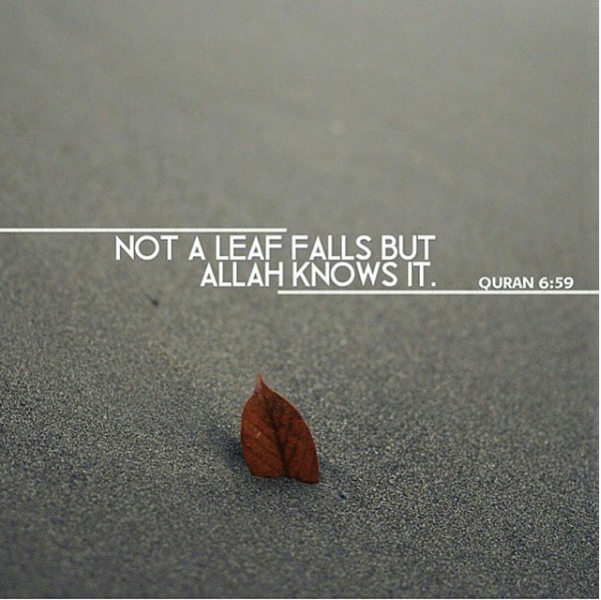
Well that renders the quran far less credible. This post claims that allah even knows when a leaf falls, yet he does not know which verses in the bible are corrupted.
The NT goes into minute and specific detail about how the OT should be interpreted, yet teh quran does not even quote a single verse from the bible that is corrupted despite the claim that the quran “corrects” previous scriptures. IT just does not.
Surely it is more important for allah to have told us which specific parts of the bible are false rather than an idle boast that he knows when a leaf falls?
LikeLiked by 1 person
More silliness you have a weird concept of Hod who know nothing
LikeLike
All your points have began answered. You are a time waster Bobby.
LikeLike
Paul,
Klng makes a good point; how come Allah doesn’t know what liberal and agnostic scholars know?
And remember, you even admitted Islamic scholar Abdel Haleem told you the Qur’an does not say that the Bible was corrupted.
“According to Paul Williams, world-renowned Islamic scholar Abdel Haleem confirmed for him in a phone conversation one of the two claims that Christians often make regarding the Bible. In the view of Professor Haleem, the Qur’an does NOT teach that the Bible was corrupted. Instead, it teaches that the Bible has been misinterpreted. Prof. Haleem’s statements in this connection, as PW says, “put Muslim apologist Bassam Zawadi (who has argued many times for the view that the Quran teaches textual corruption) in the wrong.” This, as Paul Williams also says, serves to “vindicate the oft-stated views of Sam Shamoun and David Wood.”
(Summary by Anthony Rogers)
This was at your old site, but you took it down.
All you did is call it “silliness”.
What is “Hod” ?
Is your book – Jesus as Western Scholars See Him: A Resource for Muslim Dawah Carriers
on Amazon?
Bauckham’s quote:
” . . . a much more
thoroughly and extensively interpreted version of the story of Jesus.” (p. 410)
means compared to the Synoptics (see sentence right before that, that you leave out on p. 410)
Conservative believing scholars would say that John 16:12-13 could be pointing to that –
“I have much more to reveal to you; but you cannot bear it now” (John 16:12)
Through the Holy Spirit, Jesus reveals more later and John wrote it down.
And John 16:13, with 14:26, points to “all things” and “all the truth” and “bring to your remembrance all that I have taught you”
So, the “more thoroughly and extensively interpreted version . . . ” is, according to John 14:26, and John 16:12-13, revelation from God, of the meaning of Jesus’ life and ministry and true and God-breathed.
LikeLike
Quran says the bible qot corrupted as long as you use the quranic terminlongy . I think Richard wrote an article about this topic, and you may read it with comments.
LikeLike
No; it affirms the Bible of Muhammad’s time – 10:94; 5:47; 68
It accuses a party of the Jews of changing the meaning, after hearing the true Scripture, then writing new material and claiming it was from God. (2:75, 78-79) verse 78 says they are illiterate, unlearned, that do NOT know the Scripture and just hearing things. (which is what it honestly seems like Muhammad is doing, just hearing things and making his own Scripture).
and 3:78-79 is about distorting the meaning of Scripture, not about changing the written text at all.
LikeLike
“how come God doesn’t know what liberal and agnostic scholars know?’
Rest assured Ken He knows. In Islam God knows all things – unlike Jesus who did not the date of the End (Mark 13:32)
LikeLike
But Allah of the Qur’an does not know, since He affirmed all of the Text (متن ) of the previous Scriptures. And he didn’t know the doctrine of the Trinity (5:116; 5:72-78; 112; 19:88-92; 6:101), and denied established history too. (4:157)
LikeLike
boring ZZZzzz..
all this has been refuted before Ken. You are like a broken record
LikeLiked by 1 person
Truth never changes.
Boom !
You keep saying the same thing all the time also, quoting that quote from Bauckham, and Tucket (and Barr and James D. G. Dunn, etc.)
LikeLike
indeed the same refutations of your views are unchanging
LikeLike
Zawadi’s points are refuted by the context of 2:75-79 and 3:78-79 and Dr. White and Gordon Nickel’s book, A Gentle Answer, and John Gilchrist, and many others.
LikeLike
lol as you have not bothered to even read all of his primary historical evidence your comments are worthless. Go – read – learn
LikeLike
With the name of Allah the Gracious the Merciful
The Bible is not Al Injeelu Isa -Al Masih of the Qur’an. The goodnews of Isa -Al Masih is not the Epistles of Paul or Peter or Revelation or the book of Acts. As is accepted by pretty much all of scholarship by now, Prophet Musa (p) and Isa Al Masih (p) most definitely had little to do with the current “OT” or “NT”. Those man-made writings was of uncertain origin that, at various points in time, ended up mistakenly thought of as scripture from God.
The Qur’an charges against the scripture in the possession of those who DISTORTED IT (like the greek NT and all greek materials from unknown authorship) , then claim it as the original words of God.
أَفَتَطْمَعُونَ أَن يُؤْمِنُوا لَكُمْ وَقَدْ كَانَ فَرِيقٌ مِّنْهُمْ يَسْمَعُونَ كَلَامَ اللَّهِ ثُمَّ يُحَرِّفُونَهُ مِن بَعْدِ مَا عَقَلُوهُ وَهُمْ يَعْلَمُونَ
“Do you really hope that they will believe for you even though a group of from them used to hear the words of God then CORRUPTED it (يُحَرِّفُونَهُ) after understanding it, while they were knowing?” (Qur’an 2:75)
The Qur’an is clear that there were people who wrote the book with their own hand then claim that “this is from God”. Thats why we muslims do not believe OT and NT as Words of God
“So woe to those who write the book with their own hands and say, ‘This is from God’, so that they may trade it for a small gain, woe to them for what they write with their hands, and woe to them for what they earn!” (Qur’an 2:79)
LikeLiked by 2 people
The problem with all that is that you are taking something that came 600 years later and using to interpret the Gospel and NT that was already established and existed by 96 AD. All the NT books were written from 45-96 AD; and most of them are documented as God-breathed, inspired, “canon”, & known by Irenaeus and Tertullian in 180-200 AD. They just don’t mention some of the smaller ones, like 2 and 3 John. they were already God-breathed inspired books and Origen lists all 27 as that around 250 AD and Athanasius in 367 AD. All of this is long long before the man-made Qur’an made up by Muhammad, trying to claim line of prophesy and monotheism as a “third” book of revelation. They were all “the faith” of the Gospel of Jesus Christ, Injeel Isa Al Masih long before Qur’an. And Surah 2:75-78 is only about hearing it wrong and corrupting the meaning. 2:79 describes what Muhammad did – from hearsay, and unlettered / uneducated / illiterate – hears stuff and makes up new religion. 2:79 is not about NT, since it was already God-breathed long before Qur’an – 2 Timothy 3:16. (AD 67)
LikeLike
The Qur’an is the last of series of revelation from God. It is the continuation from earlier prophetic revelation. It is fully in sync with earlier teaching. While you believe in bogus set of books which was not even written in the language of Isa Al Masih. You follow the greek, roman tradition. It is the breakaway of the semitic revelation with strange doctrines such as trinity, human sacrifice etc.
LikeLike
at the time of Qur’an (613-632 AD) he says “go ask the people of the book” Surah 10:94. and “let the people of the gospel judge by God has revealed therein” ( Surah 5:47) Since the people of the book already established their books (66 – 39 OT, 27 NT), then the Qur’an does not claim that Christians had corrupted the true Scriptures.
LikeLike
The Injil of Jesus is not the book of NT. It was the revelation given to prophet Jesus, not the collection of anonymous writing nor the writings of Paul who were never met nor was the disciple of prophet Jesus (peace be upon him).
LikeLiked by 2 people
All these points have been discussed thoroughly in the article of Richard.
These repetitive points have nothing to do with the fact that Quran refers to the texual corruption done by the people of the scripture.
LikeLiked by 1 person
Eric bin Kisam
“The Injil of Jesus is not the book of NT. It was the revelation given to prophet Jesus, not the collection of anonymous writing nor the writings of Paul who were never met nor was the disciple of prophet Jesus (peace be upon him).”
WHere is the Injil and what exactly does allah tell us is in it? That aside, where in the quran does allah reveal the exact verses, chapters and books that are corrupted in the NT?
LikeLike
Paul,
Is your book on Amazon?
LikeLike
Lol
https://www.amazon.com/Going-Stay-Old-Time-Williams-Victory/dp/B008ILO2NO/ref=sr_1_13?ie=UTF8&qid=1477159695&sr=8-13&keywords=Paul+Williams
LikeLiked by 1 person
Ken get yourself up to speed on the primary sources:
http://www.call-to-monotheism.com/evidence_that_islam_teaches_that_there_was_textual_corruption_of_the_christian_and_jewish_scriptures
LikeLike
What about Abdel Haleem ?
LikeLike
as I said before on this site – (do keep up Ken) I made a mistake and misunderstood Him
LikeLiked by 1 person
You made a mistake or Abdel Haleem made a mistake?
Where is that article ?
LikeLike
It appears i misunderstood him. Its not an article but discussions on this blog. I don’t know where they are now
LikeLike
There is a lot that I miss; I only catch some things when I have time; and I only concentrate on some of your articles that grab my attention.
LikeLike
seems that would be so important, that you would need to write a major article on it, and post it; and documenting that you misunderstood him, with his correction of your misunderstanding.
LikeLike
I don’t think so. I have already discussed this in detail.
LikeLike
But, the fact that you did not write a new post, with evidence that you misunderstood Abdel Haleem, given your powerful admission before (even vindicating Sam Shamoun and David Wood, and then deleting that old website,) is telling.
LikeLike
wtf? Just because you missed it all is not my problem Ken. And deleting the previous blog had nothing to do with that at all.
LikeLike
Do you sell your book?
Why is it not on Amazon.com ?
Are you going to get it peer reviewed by scholars?
LikeLike
It is not been published but it has been reviewed (favourably) by an academic at the University of Cambridge.
LikeLiked by 2 people
only one academic? who?
When you gunna publish?
LikeLike
Lol mind your own business. 😏
LikeLike
LikeLiked by 1 person
LOL – that’s is material for your “now for something completely different” posts.
😉
LikeLiked by 2 people
Bassam Zawadi on
Surah 2:79
Allah says in the glorious Qur’an…
Surah 2:79
Ýæíá ááÐíä íßÊÈæä ÇáßÊÇÈ ÈÇíÏíåã Ëã íÞæáæä åÐÇ ãä ÚäÏ Çááå áíÔÊÑæÇ Èå ËãäÇ ÞáíáÇ Ýæíá áåã ããÇ ßÊÈÊ ÇíÏíåã ææíá áåã ããÇ íßÓÈæä
Therefore woe be unto those who write the Book with their hands and then say, “This is from Allah,” that they may purchase a small gain therewith. Woe unto them for that their hands have written, and woe unto them for that they earn thereby.
Here we clearly see that Allah is warning those (Jews) who wrote the scripture from their own selves and then claimed that it was from God. A clear charge of TEXTUAL corruption. The verse is clear is clearly stating that whatever the Jews wrote, they claimed it was from God.
Some Christians say that the Qur’an is only talking about a specific group of people and that else where in the Qur’an it speaks about the People of the Book positively…
Zawadi is not very credible on this verse, because he left the context of Surah 2:75 – “a party of them” = a specific group; and he left out verse 78, which tells us important information that affects how we interpret verse 79.
I am the one sticking to context.
LikeLike
Man ! The corruption in your bible is crystal clear in Quran . Yes there is distortions of the meaning AND the texual corruption .
Not to mention the understaing of Sahabah, the earliest commentators in Quran such as Ibn Sumliman , Maurdi , and Altabri
. , not to mention the canonical bible that you have today is another issue according to Quran.
LikeLiked by 2 people
nope; the Qur’an affirms the Bible – 10:94; 5:47
2:75-79 and 3:79 are about distorting the meaning and writing other writings based on falsehood, hearsay, imagination, and from illiterate ones who don’t know the Scriptures.
LikeLike
I wrote this before:
Looking closely at Jesus’s comments on salvation, forgiveness, justification, the Law, God, etc suggests a set of teachings quite different to Paul’s and the standard Christian view today.
NT scholarship long ago uncovered this fact (cf the work of Johannes Weiss) and this is readily acknowledged by more liberal scholars today (eg James Barr).
A famous example would be the sacrifice-free forgiveness of sins taught by Jesus in the Lord’s Prayer. This can’t be just ignored.
– on our justification before God Jesus states unequivocally that ‘humility’ justifies a sinner in Luke 18 (cf Paul in Romans);
– obedience of the Jewish Law is *central* to discipleship in the Kingdom of God in Matthew 5:17-20, (cf Paul);
– how do we enter eternal life? by obeying the commandments says Jesus in Matt 19:17, (something Paul would never say);
– that salvation itself had come to Zacchaeus (by metanoia) was pronounced by Jesus in Luke 19 (but only available after the death & resurrection according to Paul);
– John the Baptist, revered as a great prophet in Islam, appeared proclaiming a baptism of repentance for the forgiveness of sins in Mark 1. People were baptised in the Jordan – thus their sins were forgiven;
– Jesus encouraged direct access to God the Father, (but Paul and later Christians introduced an intermediary between God and the believer);
There are numerous other examples I could recount. These sayings constitute the gospel *of* Jesus. Paul and later Christians preached a gospel *about* Jesus. The Proclaimer had become the one proclaimed. Jesus preached the Kingdom of God and it was the church that came.
The Quran acknowledges that the gospel of Jesus is to be found in the existing gospels but is not coterminous with it. Christians are called by God in his final Testament to mankind to judge what they believe by the gospel *of* Jesus, and this teaching is confirmed by the Quran. The Quran also corrects the mis-interpretations by Christians who wrongly believe Jesus is God. Jesus bears witness in the Quran that he is just a man.
Clearly the four gospels are not the Injil. They make claims (eg about the crucifixion) that God has made clear are quite unhistorical. The Quran suggests that the ‘Gospel’ (Injil) is something given to Jesus by God (surah 5:46). So it is evident that in the Qur’an the divine Gospel was one revealed to Jesus and not books written about Jesus.
A concluding quote from Montgomery Watt (who was Professor in Arabic and Islamic studies at the University of Edinburgh, and one of the foremost non-Muslim interpreters of Islam in the West):
“While it is stated that Jesus received from God a scripture called the Gospel (or Evangel – Injil), there is nothing to suggest that this was any more like our actual gospels in the New Testament than the tawrat received by Moses was like the actual Pentateuch. Indeed Muslims usually deny that our actual gospels are the book received by Jesus, since that consisted entirely of revelations from God and not of historical statements about Jesus.”
[William Montgomery Watt, Muslim-Christian Encounters. Perceptions And Misperceptions, Routledge, 1991, p. 24
I also refer you to the interesting discussion about the gospels/Injil in The Study Quran, surah 3: 3-4.
LikeLike
it says that they don’t KNOW the scripture.
but then it says woe to those who write the scripture
those who write KNOW the scripture
two different groups
LikeLiked by 1 person
Abdullah
“Man ! The corruption in your bible is crystal clear in Quran . Yes there is distortions of the meaning AND the texual corruption .
Not to mention the understaing of Sahabah, the earliest commentators in Quran such as Ibn Sumliman , Maurdi , and Altabri
. , not to mention the canonical bible that you have today is another issue according to Quran.”
Here is a very simple question – please show us the verses in the quran that state with absolute clarity, which verses in the NT have been corrupted.
WHy does allah need atheistic and skeptical scholars to explain his eternal holy book?
LikeLike
أَفَتَطْمَعُونَ أَن يُؤْمِنُوا لَكُمْ وَقَدْ كَانَ فَرِيقٌ مِّنْهُمْ يَسْمَعُونَ كَلَامَ اللَّهِ ثُمَّ يُحَرِّفُونَهُ مِن بَعْدِ مَا عَقَلُوهُ وَهُمْ يَعْلَمُونَ
SAHIH INTERNATIONAL
Do you covet [the hope, O believers], that they would believe for you while a party of them used to hear the words of Allah and then distort the Torah after they had understood it while they were knowing?
Surah 2:75
وَمِنْهُمْ أُمِّيُّونَ لَا يَعْلَمُونَ الْكِتَابَ إِلَّا أَمَانِيَّ وَإِنْ هُمْ إِلَّا يَظُنُّونَ
SAHIH INTERNATIONAL
And among them are unlettered ones who do not know the Scripture except in wishful thinking, but they are only assuming.
FARSI
و برخی از آنان بیسوادانی هستند که کتاب خدا (تورات) را جز یک مشت خیالات و آرزوها نمی دانند، و تنها به پندارهایشان دل بسته اند.
Surah 2:78
PICKTHALL
Among them are unlettered folk who know the Scripture not except from hearsay. They but guess.
They are just hearing things, not reading, not knowing, not focusing on the text; which is what seems to have happened to Muhammad himself.
Zawadi is refuted at the beginning of his article.
LikeLike
so you have all of his article with its textual evidence?
LikeLike
I looked at his comments at 2:79 and he never even addressed 2:75 or 2:78, which are in the context; after that I scrolled through the whole article and there is nothing in their about the immediate context. He jumps to 3:113-114 and 3:199; and the rest are quotes by scholars and a few Hadith, but totally avoided 2:75 and 2:78, both important to immediate context.
LikeLike
The Silence is telling.
LikeLiked by 1 person
King: “Quote some specific verses from the quran and sunnah that state exactly which verses, chapters and books of the bible are corrupted. If you can’t, that proves my point.”
What makes you think the Creator should owe you a detailed commentary on your preferred Biblical canon? Is this not the same arrogance that doomed a lot of people throughout the history of revelation?
LikeLiked by 1 person
VS
I’m asking for your benefit. Muslims assert that the bile is corrupted, allah doesn’t seem to know this since he offers no specific examples of where this occurs in the bible.
Muslims claim that the quran “corrects” the previous scriptures, yet I cannot find a single verse in the quran where it states a specific verse from the bible that it says is corrupt.
That isn’t my problem, that is a huge problem for muslims though. Atheists and skeptics know more than allah.
LikeLike
King (aka Radmod) you have already been answered several times by me and others. Discussion closed.
LikeLike