In Exodus/Shemot 3:14prophet Moses asked God what is His name, then God said to him Ehyeh ašer ehyeh אֶהְיֶה אֲשֶׁר אֶהְיֶה. The common English translation of this enigmatic phrase is: “I am what I am“, often contracted in English as “I AM” and often thought as one of God’s name. I probably think that the most literal translation of its meaning phrase from hebrew is “I Shall Be What I Shall Be“.
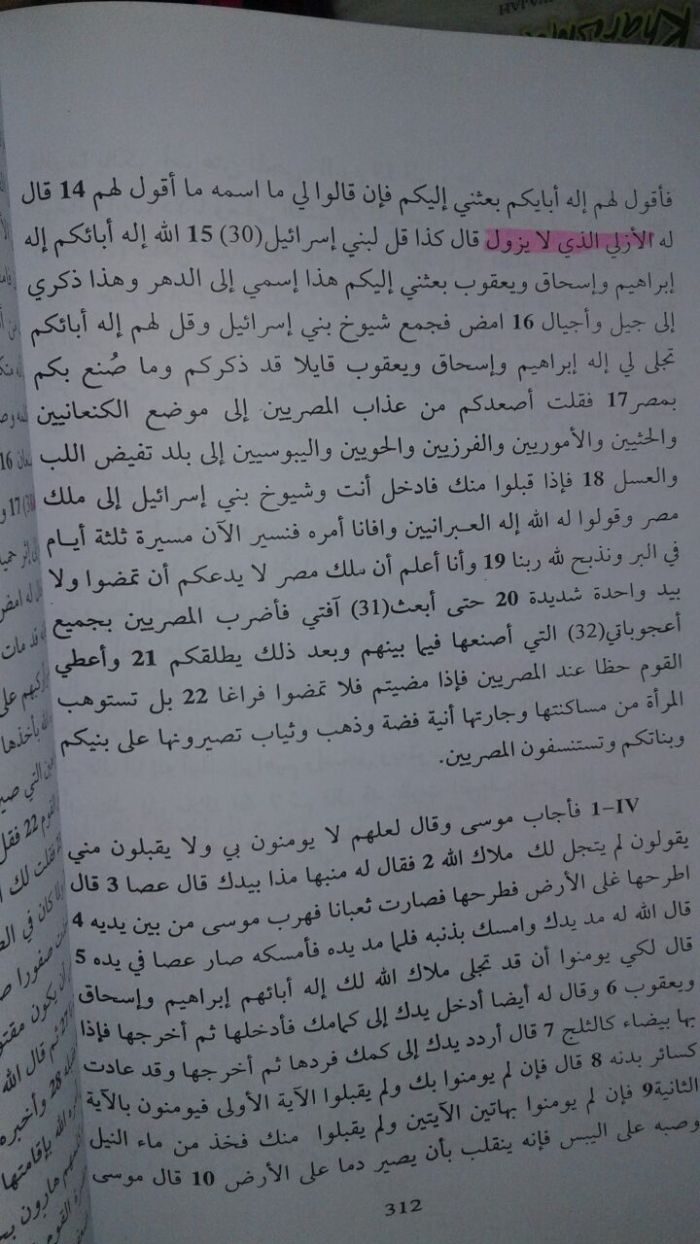
However one may wonder what this God’s Name really is? I would like draw the reader attention to the works of the great Rabbi Saadia Gaon ben Yosef (882-942) or Saʻīd bin Yūsuf al-Fayyūmi also known by the acronym “Rasag” who is the most famous Gaonic sage, a great Talmudic scholar, philosopher and hebrew grammarian.
In his Arabic translation of the Torah in Exodus 3 :14 he translated Ehyeh ašer ehyeh as “Al Azāly alladzī lā yazūlu” الأزلي الذي لا يزول which means
“The eternal which never perishes“
Interesting to note also that great medieval commentator of the Torah from rabbi Samuel ben Meir aka “Rashbam”, the grandson of rabbi Shlomo Yitzhaki, “Rashi.” also wrote on Exodus 3:14:
ויאמר אלוקים אל משה, if you do not know My name, I will tell you that I am the Eternal. This means that I can fulfill any promise I make. Now that I have told you that My name is “the Eternal,” כה תאמר, thus you shall say to the Children of Israel, “the One Who is the Eternal has sent me to you.”
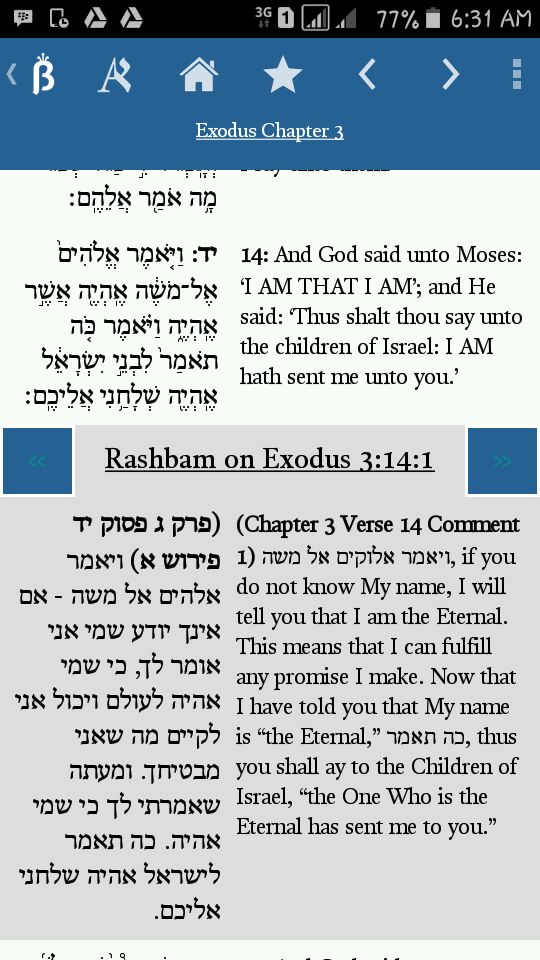
It is evident that Rashag and Rashbam rendering of the verse do away with any possibility that God is one being in Three Persons. The entirety of the existence of God is that He shall always be eternal. The trinitarian truth claims that Jesus was begotten was then invalidated. God is always ONE unseparated exclusive PERSON the ONE who never ceases to exist therefore who absolutely do not die. If there is existence that ‘eternity’ belongs to, then there is ONE who exists and will aways exist, never begotten . If there is ONE who never perishes , then there is only ONE who does. No other “personages” can be introduced.
Thus He Shall Be What He Shall Be: “The Eternal”.
 Blogging Theology
erik , this would be equivalent to al hay?
LikeLike
In a sense yes, He who is Al Hay must be the Master of eternity.
LikeLike
“la yazool ”
implying a permanent state?
LikeLike
Absolutely , for God does not Change!
LikeLiked by 1 person
Eric,
Great post.
Rabbi Saadia Gaon ben Yosef, could have translated the same phrase Ehyeh ašer ehyeh into Arabic in a variety of ways such as follows:
أنا الذي أنا: Ana alzy ana “I am that I am.”
أنا كما أنا: Ana kma ana “I am what I am”
Ygb an akon mn ana “I should be myself” (I shall be what I shall be)
The fact that Rabbi ben Yosef did not choose any of those translations can only mean that he did not understand the Hebrew phrase as being a simple “I am” statement, if he did, he would have used one of the Arabic translations above or something similar. Rather interestingly he translated it (as you pointed out) as meaning “The eternal which never perishes.” The evidence you provided from Rabbi Rashbam corroborates this understanding.
Maybe, as Edward hinted in an above comment, another translation into Arabic could be “Al-Hayy.” In that case the phrase could be related as “Ana Al-Hay” meaning “I am the everliving” or it could be “Ana Al-Hayy alladzī Ana” meaning “I am the everliving, (that is who) I am.”
So the name of God is not “I Am” (a particle of speech) but rather the holy divine name is “The Eternal/Everliving/Everlasting” which also carries the meaning of “never perishing.”
LikeLiked by 2 people
RAbbi Yosef could also have translated the phrase into Arabic as follows:
I Shall Be What I Shall Be- “Sa’kon ma sa’kon” سأكون ما سأكون
But he didn’t.
LikeLiked by 1 person
سأكون ما سأكون
we made similar inquiry here with regard to your translation, but i forgot to add in “sa” after “maa”
https://groups.google.com/forum/#!profile/sci.lang/APn2wQfPKTYXzCo-ccD7TIfJbimsQQ7Owsl72fnaOKc8tNH2R50nm9_KYVcCe1MDhdM9JSHNovkT/sci.lang/Wg9WFPFO-ko/qA3gF2jVEgAJ
LikeLike
Thanks for your insightful comment Akhi, yes the fact that Rabbi Saadia did not choose any of those translation which trinitarians could see it as a connection to John’s Jesus (“I am”) statement is significant.
LikeLike
There was a spate of interesting and/or information dense posts recently on here. This by far was the best one for me. Muslims really need to share this with other Muslims and especially our Christian friends who maybe a little confused about the name Yahweh and Allah.
Just linking back to Edward’s comment about the name Al Hayy.
It reminds me of a comment a brother sent me on this video
He wrote:
the name Al hayyal Qayum found in ayat al kursi was said by the Prophet pbuh to be the most powerful name of Allah.
this name is infact the arabic form of yahweh. both mean “he is or everliving” and this is also found by the fact that Jews in Hebrew even say Al hayyal qayum is a more precise meaning of yahweh and even syriac sources have yahweh translated in the syriac form of Yahweh.
LikeLiked by 1 person
Althoght many good points have been shown in this article, and many muslims have provided solid theories about that name, but I’ve not been absolutely comfortable with any.
I mean Allah told us in Quran the story of Moses and the burning bush. He didn’t mentioned that name unless that name is a deformed form of the name (Allah).
The name Al Rahman is used by both Arabic and Hebrew with same meaning. Elohem and Allahum as well. Also, the word ( EL) is almost used in all semetic languages.
However, that name is somehow absent.
*Halleluyah.
This term in Hebrew as I know consists of 2 words which are :
the verb (Hallal) and the short form of that name (Yah).
In Arabic the verb ( Hallal ) is identical to the hebrew one. In the Hebrew, it means to praise so does in Arabic. However, the lexiconic meaning in Arabic is to start something. Arab used that verb with good things or beautiful things. When something gets lightning including the face. His face statrs getting more bright = tahallal. When they start praising somothing with loud voice= Hallalu.
In Islam, it’s linked with Shahada ( La Elah Illa Allah), so if I want to command people to say the Kalimah, I woud command them in Arabic like this ( Halleluallah).
Also, the name (Al hayy) is a good theory. The short form of ( Yah) is combined with many names, one of which is John( Yohanan) such as John the Baptists. In Quran, that name is presented like this ( Yahya) which is the present form of the verb ( to live) in Arabic.
Allah knows the best.
LikeLiked by 1 person
//Althoght many good points have been shown in this article, and many muslims have provided solid theories about that name, but I’ve not been absolutely comfortable with any.//
The purpose of this post is to bring people attention, muslims and non-muslims alike that one of major rabbi in judaism do not see “I am” statement the way popular understanding of the phrase. God is the eternal who never perishes or pass away is very much in sync with Islamic attributes of God. It refutes the idea that God incarnate into a mere flesh, a shirk, greatest sin of all.
May Allah jalla wa ‘ala guides us always.
LikeLiked by 1 person
بارك الله فيك وجزاك الله خيراً
LikeLike
Barak Allah Feek.
LikeLike
akhee, erik,
“Watch out that you are not deceived. For many will come in my name, claiming, ‘I am he,’ and, ‘The time is near.’ Do not follow them.”
how would you translate the “i am he” in hebrew?
ani hu?
so shall we assume false messiahs will claim to be yhwh ?
lol
LikeLike