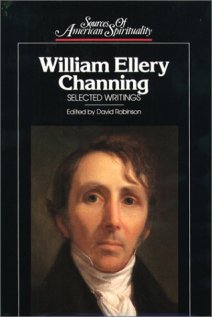
William Channing (died 1842) was the foremost Christian Unitarian preacher in the United States in the early nineteenth century. He wished to take the Reformation back beyond the manipulations of Athanasius and the political bishops of the fourth century, to discover and revive the beliefs of the earliest Christians.
Recommended reading
This was the way he thought:
‘We believe that there is one God, and one only. We object to the doctrine of the Trinity, that, it subverts in effect, the unity of God. According to this doctrine, there are three infinite and equal persons, possessing supreme divinity, called the Father, Son, and Holy Ghost. Each of these persons, as described by theologians, has his own particular consciousness, will, and perceptions. They love each other, converse with each other, and delight in each other’s society. They perform different parts in man’s redemption none doing the work of the other. The Son is mediator and not the Father. The Father sends the Son, and is not himself sent; nor is he conscious, like the Son, of taking flesh. Here, then, we have three intelligent agents, possessed of different perceptions, performing different acts, and sustaining different relations; and if these things do not imply three minds, we are at a loss to know how three minds are to be formed.
We protest against the irrational and unscriptural doctrine of the Trinity. To us, as to the Apostle and the [original] Christians, there is one God, even the Father. We challenge our opponents to [point out] one passage in the New Testament, where the word God means three persons.
This doctrine, were it true, must, from its difficulty, singularity, and importance, have been laid down with great clearness and stated with all possible precision. But where does this statement appear? From the many passages which treat of God, we ask for one, one only, in which we are told, that he is a threefold being. So entirely do the Scriptures abstain from stating the Trinity, that when our opponents would insert it into their creeds they are compelled to leave the Bible, and to invent forms of words altogether unsanctioned by Scriptural phraseology.
We have further objections to this doctrine, drawn from its practical influence. We regard it as unfavorable to devotion, by dividing and distracting the mind in its communion with God. It is a great excellence of the doctrine of God’s unity, that it offers to us ONE OBJECT of supreme homage, adoration, and love, One Infinite Father, to whom we may refer all good.’
***
Channing also speaks passionately against the injustice implied in the Blood Atonement. This resonated with Tim Winter, not then a Muslim, who speaks of the influence Chaining had on him in his teenage years,
“I recalled how, as a schoolboy aged perhaps nine, I had sat in services at an Anglican church in Hampstead, gazing at an enormous and bleeding Christ. How small, and how guilty I felt! The message was, as the hymnal confirmed, that this suffering was the consequence of my own sinfulness. How ungrateful I would be, a voice would whisper, not to accept this heroic deed! Later, as a frank and turbulent teenager, I was able to call this kind of religion ‘blackmail’. The gruesome image was oppressing me into faith.”
But was there a God who could forgive directly?”
Quotation from Quicunque Vult, or, A teenage journey to Islam by Shaikh Abdal Hakim Murad
Categories: Abdal-Hakim Murad, Bible, God, Islam, London
 Blogging Theology
Please leave a Reply