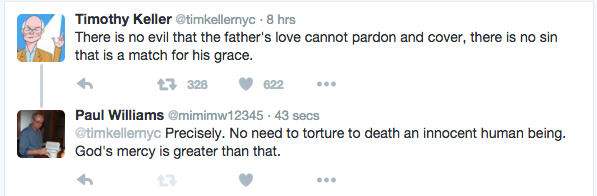
Great point….even worse to torture to death someone even better than a human …infinitely worse to torture someone who is infinitely good such as God or God’s son (if it is coherent for God to have a son…it is not coherent).
Question: Islam teaches that Allah’s will is arbitrary. He can forgive whomever He wills according to the Qur’an. If Allah can forgive you without punishing you, how does Allah balance between mercy and justice when granting or denying salvation to people? In Christianity, God has punished all sin so we don’t have to worry about this.
Islam does not teach that Allah’s Will is arbitrary. In fact, Allah’s Will is exercised or expressed in accordance to His Divine nature and Wisdom. Sin is not a thing – that exists by itself independent of volitional actors – which needs punishing when committed. A woman is not sin, neither are our eyes, or our hearts. But the action of the eye or the heart when looking at a woman with lust is a sin. Sin does not exist as an entity – wrongly conceived in Christianity – which you can punish. Punishing the actors of sin has a meaning and not punishing the sin.
We do not believe that Allah needs to express both His Mercy and Justice on every individual at the same time at all times. His Justice is carried out on every individual in perfect wisdom. No one will be wronged, for everyone gets their due (as good and bad is explained through the prophets and messengers at all times in human history). Any good one has done or any bad one has done – be they small or big – will be accounted for. That’s the Justice of God.
His Mercy however, though in a general sense is open to all in this life (as understood from His name Al-Rahman). The Qur’an states:
Surah 3:31
Say (Oh Muhammad): If you love Allah, then follow me, Allah will love you and forgive you your faults, and Allah is Forgiving, Merciful
Here we see that the Prophet Muhammad (peace be upon him) is commanded to tell the people that they must follow his guidance, which was revealed to him by Allah in order to receive Allah’s love. Allah says:
Surah 21:107
And We have not sent you but as a mercy to the worlds.
So here we see that Allah is offering His love and mercy to everyone in the form of Islam. If one rejects Islam then he or she is rejecting Allah’s offer of love in turn. It’s not an issue of Allah not wanting to love the person, but an issue of the person not allowing Allah’s love to reach him.
Allah has declared to humanity about His nature:
Surah 7:156
My Mercy encompasses all things
Surah 6:12
He has taken it upon Himself to be Merciful
Allah’s Messenger (peace be upon him) said:
When Allah created the creation He put down in his Book, which is with Him upon the Throne: Verily, My mercy prevails over My wrath. (Sahih Muslim 4939)
He has however, in a specific sense, reserved the abundant mercy (Surah 7:156) for the believers in the hereafter (as understood from His name Al-Raheem).
God by taking on to Himself to be Merciful, which prevails over His wrath (i.e. punishing through Justice) has told us how He expresses these two apparently contradictory attributes. His attributes therefore are complimentary.
There are two kinds of sins that could occur. One is sin against God and the other is sin against creation. If we sin against God, it is entirely within God’s prerogative to forgive us. If we sin against humanity more than one thing could occur. 1) He whom I sinned against could forgive me for my crime or 2) God could forgive me for my crime and then recompense the victim in order to ensure overall justice.
Furthermore, God could punish me in this life for my crimes without punishing me in hell. For example, he could punish me with trials in this life. He could punish me in the grave. He could punish me and wipe out my sins by making me feel pain when the angel of death is pulling out my soul. He could temporarily punish me in hell for any sins that I committed.
This doesn’t contradict God being All Merciful. We don’t define All Just and All Merciful as meaning that God should be fully just and fully merciful with a human being at all given times. Surely, Muslims and Christians alike would agree that God won’t be merciful to the disbelievers on the Day of Judgment for instance. Rather, when we say that God is All Merciful or All Just we mean to say that His ability to exercise these two attributes is infinitely vast, but whether He decides to exercise them is entirely up to His will that is in accordance with His nature.
Also, we should bear in mind that Justice does not always denote vengeance or punishment. Sometimes forgiveness and display of mercy could be an act of justice. Allah’s forgiving someone for a sin without punishing him for it does not mean that Allah compromised His Justice. Human beings are created weak and are meant to fall into sin from time to time. There is no reason to believe that we deserve to be punished for every single thing that we do. We will expand more on this point below.
2) You Muslims aren’t even sure whether you have attained salvation. For crying out loud, Muhammad himself wasn’t sure if he would go to heaven according to an authentic hadeeth, so how could you be!?
It is not correct that Muslims aren’t sure whether they have attained salvation or not. Muslims have a guarantee of salvation and Promise from God to that matter.
Allah states:
Surah 9:72
Allah has promised to the believers -men and women, – Gardens under which rivers flow to dwell therein forever, and beautiful mansions in Gardens of ‘Adn (Eden Paradise). But the greatest bliss is the Good Pleasure of Allah. That is the supreme success.
Allah also states:
Surah 3:9
Verily, Allah never breaks His Promise
Now if you ask the Muslim “are you going to paradise?” he is going to say to you “if Allah wills” (insha’allah). The well informed Muslim is not going to tell you “Yes I am going paradise for sure.” No, the Muslim hopes and prays that he will end up in paradise. It’s not because the Muslim is worried whether Allah will keep His promise, for as we have seen Allah does not break His promise. Rather, it is because the Muslim cannot be sure whether he would continue remaining on the straight path and die as a Muslim and the guarantee or promise of salvation is conditional in remaining and dying as a Muslim.
As for Christians, well there is no consensus regarding this matter.
If you are a Calvinist you would adhere to the doctrine of the preservation of saints, which basically states that once you’re saved, you’re always saved. Once the Holy Spirit dwells in you it will never leave you. But if you happen to be following the Arminian school of thought you would take a different stance and take a position similar to what Muslims take, which is the doctrine of conditional preservation of the saints, which states that there must be a condition for one to be saved and it is possible for one to lose that status.
“As for Christians, well there is no consensus regarding this matter.”
Precisely. I assume if we asked Mark what he means by “his love and grace are most powerfully demonstrated in the cross”, it will all dissolve into “mystery” eventually.
You said;
Except his love and grace are most powerfully demonstrated in the cross according to Christianity.
Allan’s mercy is arbitrary.
I say;
Before the cross:
Sometimes God love and sometimes God does not love i.e. God does not love sinners because He will punish them. Why will God punish the sinners? Because He does not love them sinning and He punishes them(sinners) but cannot punish the sin itself because a “sin” is not a substance to be punished.
After the cross:
Sometimes God love and sometimes God does not love i.e. God does not love sinners because He will punish them. Why will God punish the sinners? Because He does not love them sinning and He punishes them(sinners) but cannot punish the sin itself because a “sin” is not a substance to be punished.
Conclusion:
Nothing changed before and after the cross and the cross becomes useless, unless those sinning Christians like the Church Fathers, Jimmy Swaggart, Pastor Eddie Lee Long etc. who are worse sex offenders in this world will not be punished and can continue to sin without punishment because all their sins has already been paid by the death of Jesus. It will not be justice by Christ for the raped victims.
Well, Jesus arbitrary committed suicide and could not forgive anyone’s sins. Christians still have to repent when they do sin, like Muslims and anyone else.
Despite arbitrary the Trinitarian God who is immortal(cannot die) contradicted Himself and died, He could not save Christians because they have to repent and ask for forgiveness when they sin.
“a position similar to what Muslims take, which is the doctrine of conditional preservation of the saints, which states that there must be a condition for one to be saved and it is possible for one to lose that status”
“He forgives whom he choses”
Paul, you are saying contradictory things.
If you can lose your status, then it is not only Allah whom chooses to forgive. It seems to me that “western” Muslims are uncomfortable with the Islamic understanding of predestination so are introducing more western philosophical notions into their teaching.
Can you provide any traditional scholars who would teach predestination as you describe above?
That the individual has free will by means of which he acts, as God says:
“To whomsoever among you who wills to walk straight” [Q 81:28]
However
That individual’s will and ability do not operate outside the will and decree of God, the All Knower.
“And you cannot will unless (it be) that Allah wills the Lord of the worlds(mankind, unseen and all that exists)” [Q81:29]
We do not dispute with God concerning His authority to whom full He forgives whom he chooses. We muslim must trust God’s perfect justice and love and never question about what He does.
This position are held by virtually all scholars of Sunni Islam.
“If we sin against God, it is entirely within God’s prerogative to forgive us.”
***Not entirely? Only if we repent? What if we don’t?
” If we sin against humanity more than one thing could occur. 1) He whom I sinned against could forgive me for my crime”
***But in that case is he more merciful than God? Unless God overrules his law and signalizes somehow that he has done so. Has Allah ever done this?
or 2) God could forgive me for my crime and then recompense the victim in order to ensure overall justice.”
***Again, dependent on our repentance and the forgiveness of the victim or his family? In this case they would be more merciful than God because God can only show mercy after the family has shown mercy.
God recompenses the victim? How?
All in all Allah’s mercy seems to be dependant upon man’s mercy does it not? So can it be that great?
You said;
“If we sin against God, it is entirely within God’s prerogative to forgive us.”
***Not entirely? Only if we repent? What if we don’t?
” If we sin against humanity more than one thing could occur. 1) He whom I sinned against could forgive me for my crime”
***But in that case is he more merciful than God? Unless God overrules his law and signalizes somehow that he has done so. Has Allah ever done this?
or 2) God could forgive me for my crime and then recompense the victim in order to ensure overall justice.”
***Again, dependent on our repentance and the forgiveness of the victim or his family? In this case they would be more merciful than God because God can only show mercy after the family has shown mercy.
God recompenses the victim? How?
All in all Allah’s mercy seems to be dependant upon man’s mercy does it not? So can it be that great?
I say;
If I steal your car and my heart tells me I did wrong to you and my hearts inclinations towards righteousness fought back my evil inclination and won and I returned your car and you decided to forgive me and not to prosecute me or take things further.
What do you want God to do in this case? Common sense demands God not to interfere in this case because at the end of the day two human beings have settled their problem and cancelled the problem of sin. So God will not punish anyone including the stealing because the stealing has been cancelled with my righteousness because God wants us to be righteous all the time.
It is only a wicked God who will punish someone in this situation. Similarly, if someone commits crime to others and sincerely repents and the victims determined to forgive him(perpetrator) then do you want God not to forgive the perpetrator as well? if God’s divine wisdom has determined that the perpetrator has indeed sincerely repented.
Sincerely repentance is key to forgiveness because it disallow the person from performing such crime again. Do you want continues crime before one repents?
 Blogging Theology
Great point….even worse to torture to death someone even better than a human …infinitely worse to torture someone who is infinitely good such as God or God’s son (if it is coherent for God to have a son…it is not coherent).
LikeLike
Touché
LikeLiked by 1 person
Except his love and grace are most powerfully demonstrated in the cross according to Christianity.
Allan’s mercy is arbitrary.
LikeLike
you have not explained how it is just or loving for God to require the torturing to death of an innocent human being for our sins to be forgiven.
God’s mercy is not arbitrary, He forgives whom he choses, according to His great wisdom and love.
LikeLike
The following is taken from Answering Common Questions on Salvation That Christians Pose to Muslims
Question: Islam teaches that Allah’s will is arbitrary. He can forgive whomever He wills according to the Qur’an. If Allah can forgive you without punishing you, how does Allah balance between mercy and justice when granting or denying salvation to people? In Christianity, God has punished all sin so we don’t have to worry about this.
Islam does not teach that Allah’s Will is arbitrary. In fact, Allah’s Will is exercised or expressed in accordance to His Divine nature and Wisdom. Sin is not a thing – that exists by itself independent of volitional actors – which needs punishing when committed. A woman is not sin, neither are our eyes, or our hearts. But the action of the eye or the heart when looking at a woman with lust is a sin. Sin does not exist as an entity – wrongly conceived in Christianity – which you can punish. Punishing the actors of sin has a meaning and not punishing the sin.
We do not believe that Allah needs to express both His Mercy and Justice on every individual at the same time at all times. His Justice is carried out on every individual in perfect wisdom. No one will be wronged, for everyone gets their due (as good and bad is explained through the prophets and messengers at all times in human history). Any good one has done or any bad one has done – be they small or big – will be accounted for. That’s the Justice of God.
His Mercy however, though in a general sense is open to all in this life (as understood from His name Al-Rahman). The Qur’an states:
Surah 3:31
Say (Oh Muhammad): If you love Allah, then follow me, Allah will love you and forgive you your faults, and Allah is Forgiving, Merciful
Here we see that the Prophet Muhammad (peace be upon him) is commanded to tell the people that they must follow his guidance, which was revealed to him by Allah in order to receive Allah’s love. Allah says:
Surah 21:107
And We have not sent you but as a mercy to the worlds.
So here we see that Allah is offering His love and mercy to everyone in the form of Islam. If one rejects Islam then he or she is rejecting Allah’s offer of love in turn. It’s not an issue of Allah not wanting to love the person, but an issue of the person not allowing Allah’s love to reach him.
Allah has declared to humanity about His nature:
Surah 7:156
My Mercy encompasses all things
Surah 6:12
He has taken it upon Himself to be Merciful
Allah’s Messenger (peace be upon him) said:
When Allah created the creation He put down in his Book, which is with Him upon the Throne: Verily, My mercy prevails over My wrath. (Sahih Muslim 4939)
He has however, in a specific sense, reserved the abundant mercy (Surah 7:156) for the believers in the hereafter (as understood from His name Al-Raheem).
God by taking on to Himself to be Merciful, which prevails over His wrath (i.e. punishing through Justice) has told us how He expresses these two apparently contradictory attributes. His attributes therefore are complimentary.
There are two kinds of sins that could occur. One is sin against God and the other is sin against creation. If we sin against God, it is entirely within God’s prerogative to forgive us. If we sin against humanity more than one thing could occur. 1) He whom I sinned against could forgive me for my crime or 2) God could forgive me for my crime and then recompense the victim in order to ensure overall justice.
Furthermore, God could punish me in this life for my crimes without punishing me in hell. For example, he could punish me with trials in this life. He could punish me in the grave. He could punish me and wipe out my sins by making me feel pain when the angel of death is pulling out my soul. He could temporarily punish me in hell for any sins that I committed.
This doesn’t contradict God being All Merciful. We don’t define All Just and All Merciful as meaning that God should be fully just and fully merciful with a human being at all given times. Surely, Muslims and Christians alike would agree that God won’t be merciful to the disbelievers on the Day of Judgment for instance. Rather, when we say that God is All Merciful or All Just we mean to say that His ability to exercise these two attributes is infinitely vast, but whether He decides to exercise them is entirely up to His will that is in accordance with His nature.
Also, we should bear in mind that Justice does not always denote vengeance or punishment. Sometimes forgiveness and display of mercy could be an act of justice. Allah’s forgiving someone for a sin without punishing him for it does not mean that Allah compromised His Justice. Human beings are created weak and are meant to fall into sin from time to time. There is no reason to believe that we deserve to be punished for every single thing that we do. We will expand more on this point below.
2) You Muslims aren’t even sure whether you have attained salvation. For crying out loud, Muhammad himself wasn’t sure if he would go to heaven according to an authentic hadeeth, so how could you be!?
It is not correct that Muslims aren’t sure whether they have attained salvation or not. Muslims have a guarantee of salvation and Promise from God to that matter.
Allah states:
Surah 9:72
Allah has promised to the believers -men and women, – Gardens under which rivers flow to dwell therein forever, and beautiful mansions in Gardens of ‘Adn (Eden Paradise). But the greatest bliss is the Good Pleasure of Allah. That is the supreme success.
Allah also states:
Surah 3:9
Verily, Allah never breaks His Promise
Now if you ask the Muslim “are you going to paradise?” he is going to say to you “if Allah wills” (insha’allah). The well informed Muslim is not going to tell you “Yes I am going paradise for sure.” No, the Muslim hopes and prays that he will end up in paradise. It’s not because the Muslim is worried whether Allah will keep His promise, for as we have seen Allah does not break His promise. Rather, it is because the Muslim cannot be sure whether he would continue remaining on the straight path and die as a Muslim and the guarantee or promise of salvation is conditional in remaining and dying as a Muslim.
As for Christians, well there is no consensus regarding this matter.
If you are a Calvinist you would adhere to the doctrine of the preservation of saints, which basically states that once you’re saved, you’re always saved. Once the Holy Spirit dwells in you it will never leave you. But if you happen to be following the Arminian school of thought you would take a different stance and take a position similar to what Muslims take, which is the doctrine of conditional preservation of the saints, which states that there must be a condition for one to be saved and it is possible for one to lose that status.
LikeLiked by 1 person
“As for Christians, well there is no consensus regarding this matter.”
Precisely. I assume if we asked Mark what he means by “his love and grace are most powerfully demonstrated in the cross”, it will all dissolve into “mystery” eventually.
LikeLike
Mark
You said;
Except his love and grace are most powerfully demonstrated in the cross according to Christianity.
Allan’s mercy is arbitrary.
I say;
Before the cross:
Sometimes God love and sometimes God does not love i.e. God does not love sinners because He will punish them. Why will God punish the sinners? Because He does not love them sinning and He punishes them(sinners) but cannot punish the sin itself because a “sin” is not a substance to be punished.
After the cross:
Sometimes God love and sometimes God does not love i.e. God does not love sinners because He will punish them. Why will God punish the sinners? Because He does not love them sinning and He punishes them(sinners) but cannot punish the sin itself because a “sin” is not a substance to be punished.
Conclusion:
Nothing changed before and after the cross and the cross becomes useless, unless those sinning Christians like the Church Fathers, Jimmy Swaggart, Pastor Eddie Lee Long etc. who are worse sex offenders in this world will not be punished and can continue to sin without punishment because all their sins has already been paid by the death of Jesus. It will not be justice by Christ for the raped victims.
Thanks.
LikeLike
“He forgives whom he choses, according to His great wisdom and love.”
Precisely. Completely arbitary. Couldn’t say it better myself.
LikeLike
Mark
Are you using arbitrary word to insult our God?
Well, Jesus arbitrary committed suicide and could not forgive anyone’s sins. Christians still have to repent when they do sin, like Muslims and anyone else.
Despite arbitrary the Trinitarian God who is immortal(cannot die) contradicted Himself and died, He could not save Christians because they have to repent and ask for forgiveness when they sin.
Thanks
LikeLike
“a position similar to what Muslims take, which is the doctrine of conditional preservation of the saints, which states that there must be a condition for one to be saved and it is possible for one to lose that status”
“He forgives whom he choses”
Paul, you are saying contradictory things.
If you can lose your status, then it is not only Allah whom chooses to forgive. It seems to me that “western” Muslims are uncomfortable with the Islamic understanding of predestination so are introducing more western philosophical notions into their teaching.
Can you provide any traditional scholars who would teach predestination as you describe above?
LikeLike
With the name of Allah
It is the belief of all of Sunni Islam that :
That the individual has free will by means of which he acts, as God says:
However
That individual’s will and ability do not operate outside the will and decree of God, the All Knower.
We do not dispute with God concerning His authority to whom full He forgives whom he chooses. We muslim must trust God’s perfect justice and love and never question about what He does.
This position are held by virtually all scholars of Sunni Islam.
LikeLike
“If we sin against God, it is entirely within God’s prerogative to forgive us.”
***Not entirely? Only if we repent? What if we don’t?
” If we sin against humanity more than one thing could occur. 1) He whom I sinned against could forgive me for my crime”
***But in that case is he more merciful than God? Unless God overrules his law and signalizes somehow that he has done so. Has Allah ever done this?
or 2) God could forgive me for my crime and then recompense the victim in order to ensure overall justice.”
***Again, dependent on our repentance and the forgiveness of the victim or his family? In this case they would be more merciful than God because God can only show mercy after the family has shown mercy.
God recompenses the victim? How?
All in all Allah’s mercy seems to be dependant upon man’s mercy does it not? So can it be that great?
LikeLike
madmanna
You said;
“If we sin against God, it is entirely within God’s prerogative to forgive us.”
***Not entirely? Only if we repent? What if we don’t?
” If we sin against humanity more than one thing could occur. 1) He whom I sinned against could forgive me for my crime”
***But in that case is he more merciful than God? Unless God overrules his law and signalizes somehow that he has done so. Has Allah ever done this?
or 2) God could forgive me for my crime and then recompense the victim in order to ensure overall justice.”
***Again, dependent on our repentance and the forgiveness of the victim or his family? In this case they would be more merciful than God because God can only show mercy after the family has shown mercy.
God recompenses the victim? How?
All in all Allah’s mercy seems to be dependant upon man’s mercy does it not? So can it be that great?
I say;
If I steal your car and my heart tells me I did wrong to you and my hearts inclinations towards righteousness fought back my evil inclination and won and I returned your car and you decided to forgive me and not to prosecute me or take things further.
What do you want God to do in this case? Common sense demands God not to interfere in this case because at the end of the day two human beings have settled their problem and cancelled the problem of sin. So God will not punish anyone including the stealing because the stealing has been cancelled with my righteousness because God wants us to be righteous all the time.
It is only a wicked God who will punish someone in this situation. Similarly, if someone commits crime to others and sincerely repents and the victims determined to forgive him(perpetrator) then do you want God not to forgive the perpetrator as well? if God’s divine wisdom has determined that the perpetrator has indeed sincerely repented.
Sincerely repentance is key to forgiveness because it disallow the person from performing such crime again. Do you want continues crime before one repents?
Thanks.
LikeLike