Credo quia absurdum is a Latin phrase that means “I believe because it is absurd.” It is a paraphrase of a statement by the early Christian theologian Tertullian in his work De Carne Christi (written AD 203-206). Realising the intractable difficulties to be found with key Christian doctrines such as the incarnation and the Trinity, Tertullian made a virtue of necessity: its absurd so I’ll believe it!
However, the Bible is absolutely right when it exclaims:
The blessed and only almighty God, the King of all kings and Lord of all lords, He alone can never die, and he lives in light so brilliant that no human can approach him. No human eye has ever seen him, nor ever will. All honor and power to him forever! Amen.
1 Timothy 6 in the NLT
According to Christian belief Jesus died, therefore according to the teaching of 1 Tim 6 he could not have been God, who is immortal, ie he can never die. Also the passage says no human eye has ever seen God nor ever will, yet many saw Jesus. On all these grounds, which cohere perfectly with Islamic teaching about God’s eternal nature and the purely human nature Jesus one might conclude that it is just absurd to believe in absurd ideas.
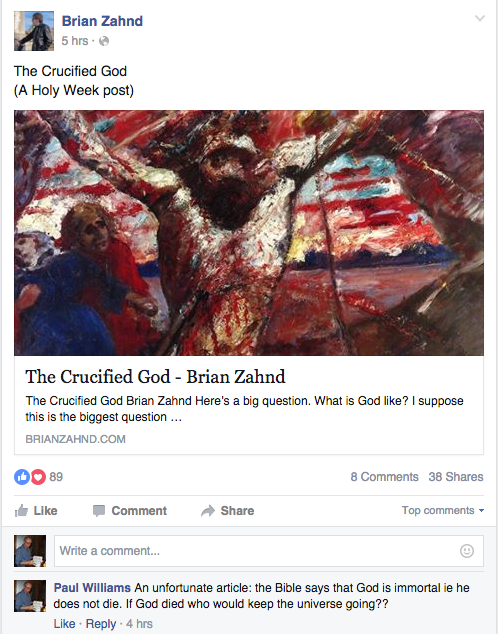
This post was inspired by an article on Facebook today by a Christian minister which talks absurdly of The Crucified God:
Categories: Christianity, God
 Blogging Theology
I do not see the problem here. Christians are not saying that God qua God can die (that would be more than absurd- it would be a contradiction in terms) but that God can experience death through the incarnation of His Word (Logos). I do not see how that is a logical problem. If God’s Word (Logos) became incarnate in Jesus Christ then it follows that the Word can experience death.
Think about it. There is a sense in which even human beings do not die because we continue to exist after death. What dies is the body.
LikeLiked by 1 person
Mike
Whatever death means, the Bible said God cannot die in any way shape or form. Any one who says God died in any way, shape or form has committed blaspheme and a big sin and without repenting will be put in fire.
I am not saying it but the Bible said God is immortal.
God experience death? If you experience death, then you have died. You either die or not die. You cannot experience death.
Thanks.
LikeLike
God doesn’t need to “experience” anything. That is why He is God.
LikeLiked by 1 person
Mike gets it!! Good job Mike!
LikeLike
Ken
You have said nothing to defend poor Mike who could not defend the indefensible God dying blaspheme.
When the Word(Logos) became flesh, another person was generated. Every person is a being, whether God or man. If the Son is generated by the Father from eternity, then two persons and two beings existed. When the Word(Logos) became flesh and incarnated another person is generated and so we have 3 persons or 3 beings. You add the Holy Spirit, then we get 4 persons or 4 beings and it is polytheism to worship multiple beings.
Thanks.
LikeLike
I get Mike point also,: using trinitarian logic, there is no such a thing as “death” as philosophically human beings do not die because we continue to exist after death. What dies is the body.
So this really a devastating refutation of trinitarian who think that Jesus is God because he overcame death, and that God did not die but only cease his “physical/humanly” body (whatever that means). That makes we human are all gods….
LikeLiked by 2 people
Mike
you said ‘Christians are not saying that God qua God can die’
actually many do say precisely this. I have spoken to numerous Christians (lay and ordained) who say this and even some leading theologians claim this. I’m surprised you were not aware of this.
LikeLiked by 1 person
Now everything is messed up, …now I have a question to Temple, since he does not seem to think that God can die (I am hoping if Temple is getting closer to become muslim now coz this what muslim believe)
…Did Jesus (God, the 2nd person of the three godhead) die or not?
LikeLiked by 1 person
Mike “I do not see how that is a logical problem.”
Contradiction – you have a God that dies and does not die both at the same time. A God that is God and is not God both at the same time.
LikeLike
now I have a question to Temple, since he does not seem to think that God can die (I am hoping if Temple is getting closer to become muslim now coz this what muslim believe)
…Did Jesus (God, the 2nd person of the three godhead) die or not?
Jesus did die on the cross. you left out that He was “the God-man” (100 % God and 100 % man) – the human body died. But also being God, He raised Himself up from the dead –
John 10:18
No one takes my life from Me; I lay it down voluntarily on My own authority,
I have authority to lay down My life, and I have authority to take it up again.
John 2:19-22
“destroy this temple, and I will raise it up on the third day”
“He was speaking about the temple of His body.”
LikeLike
I was not aware than anyone had responded to my post so now I have too much to respond to.
Paul Williams: I can think of no serious theologian (Augustine, Thomas Aquinas, Karl Barth, Carl Rahner) who thought that God qua God can die. That would be a contradiction (such as a square-circle) and such contradictions cannot obtain in reality.
What do I mean by “God qua God cannot die”? I mean that God is “Ipsum esse subsistents” (Thomas Aquinas) which could be translated as “Being-Itself”. In other words there is no distinction in God between his existence and his essence (as there is in all created realities such as ourselves). I can think of the essence or nature of a Unicorn but it doesn’t follow from this that Unicorns exist, In other words: the coincidence of essence and existence in created things is contingent and does not have to obtain in the real world. But the coincidence of God’s nature and existence is not contingent; it is necessary. God exists- and could not not exist (if you may allow the double negative). In short: there has to be something whose non-existence is impossible; and that we call God.
This is what it means to say that God cannot die. Jews, Christians and Muslims all agree in this. (Just to be clear: I have never read a Christian theologian who would deny what I have written above; indeed I derive much of it from Thomas Aquinas, arguably the greatest Christian thinker). But can now we have to factor in the Christian belief in the incarnation. So, I want to explain what I understand by this first.
Christian theologians (such as Thomas Aquinas) do not say that Jesus is God. That might come as a surprise to some but it is nevertheless an accurate statement. No serious trinitarian theologian has ever claimed that Jesus is numerically identical to God (that would be the heresy of Monarchianism/Modalism). St. Thomas Aquinas understands Jesus to be the “Logos” (Word or expression) of God. There is (according to Aquinas) real distinction in God between the “persons” of the trinity; and it was the second “person” who became incarnate (not the Father and not the Holy Spirit but the Son). Therefore to say that Jesus is “God” (without qualifying that statement) is in fact a heresy. There might be some Christians who say this but they are misinformed. It is Monarachianism, which is heretical.
What then does the incarnation signify? It means that the Son/Logos(Word of God) became incarnate in the man Jesus. Notice that this means that neither the Father nor the Spirit were incarnated in Jesus- thus we cannot speak of Jesus as “God” since for Christians God is Father, Son and HS. However the Logos is consubstantial with the Father and the HS which means that he shares the same nature as they do. Now the nature of a thing determines how we are to speak of it (thus if you know what the nature of a lion is then you know how to speak about it). If someone said: “I like its wooly coat and its gentle bleating” you would not think a lion was being referred to here; that is because you know what the nature of a lion is. So: the nature of a thing determines how we can speak of it. But if the incarnation happened then we have two ways in which to talk about Jesus because (according to Christians) he is one divine subject in two natures (one divine and one human). Therefore (according to the logic of Christian belief) we can talk of Jesus qua his divine nature and qua his human nature. Thus: “Jesus ate and slept” and “Jesus created the heavens and the earth” equally make sense within the internal logic of Christian belief (i.e., if x, then y, then, etc: if the incarnation, then this, that, and the other). In short: since for Christians the subject term (Jesus) refers to a person with two natures (one divine, one human) then both divine and human terms can be predicated of that subject.
What then do I understand by “God died on the cross”? Clearly it was not God qua God (that is an a priori impossiblity; and Christian theologians are not so foolish as to make that claim). However if we follow the logic of Christian belief then it follows that we can change the subject term from “God” to “Jesus” due to his two natures. We can say that God died because Jesus died; or, in other words, we can say that God died in Jesus qua his human nature, not qua his divine nature, which is essentially immortal.
The sentence: “God died on the cross” is ONLY absurd if and only if the incarnation is impossible, so it seems to me that you are arguing from the wrong end here. I do not believe that God died because I do not believe in the incarnation; but if I did believe in the incarnation then I would have no problem with the notion that God died (as explained above). But just to repeat the main points: (1) I am NOT saying that God qua God can die (that IS absurd); but that God qua the incarnation (i.e., two natures of Christ) can be said to have died, not in His essential nature, but in his human nature to which he was joined.
LikeLike
I will reply in full when i get home: but it is factually incorrect to say no Christian believe God died on the cross, and it is erroneous to believe Aquinas did not affirm that Jesus was God. He is far far from being the only theologian in the Christian church.
More later..
LikeLike
Mike gets it really well! Finally a Muslim who understands the incarnation and Trinity fairly from the Christian’s own understanding!
Mike, are you a “former Christian”? (Roman Catholic ? – your knowledge of Latin and Aquinas is good)
LikeLike
Ken praising the Roman Catholic view OMG!!
LikeLiked by 1 person
Jesus was God by nature = same substance (homo-ousias); but Jesus was not the Father – that is modalism or Monarchianism – heresy. Just as Mike wrote.
God in Jesus as the incarnate Son of God (homo-sousias = same nature) died; but God qua (as purely) God did not die.
since the Father did not become incarnate, neither the Holy Spirit, and Jesus’ Divine nature cannot “die” – the human body died. Death is separation of the soul/spirit from the body.
souls continue on; and will be judged at judgment day, even Islam agrees with this.
LikeLike
Protestants and Roman Catholics are unified in the issues of the incarnation, Deity of Christ, two natures of Christ, the Trinity.
Always have.
LikeLike
You end up with a God that dies and does not die both at the same time.
LikeLike
‘since the Father did not become incarnate, neither the Holy Spirit, and Jesus’ Divine nature cannot “die” – the human body died.’
The idea that God should desire a human sacrifice to atone for sin is repugnant – and condemned by God in the Jewish scriptures.
LikeLike
“The idea that God should desire a human sacrifice to atone for sin is repugnant – and condemned by God in the Jewish scriptures”.
It is- but that is a quite separate issue. We are discussing the proposition “God died on the cross” and to what extent it is logical or illogical.
As I have mentioned previously, substitutionary atonement theory is a modern invention and was not held by the Church Fathers.
LikeLike
Paul Williams: “I will reply in full when i get home: but it is factually incorrect to say no Christian believe God died on the cross, and it is erroneous to believe Aquinas did not affirm that Jesus was God. He is far far from being the only theologian in the Christian church”.
(1) I never denied that Christians maintain that God died on the cross- I was pointing out that this is misunderstood and needs to be clarified. No Christian theologian has ever maintained that God qua God died on the cross. But they have maintained that since Jesus is one subject with two natures (one human, one divine) we have two ways of speaking about Jesus (the nature of a thing determines how we can speak about it). “God died on the cross” means (for Christians) that Jesus is one person but with two natures; it was the body of Jesus that died (from his human nature) not the divine nature (since that which is divine is necessarily immortal). If you think about it even for humans it is only the body that dies; the soul continues to exist. What we mean by death is the separation of soul and body. Death just is the death of the body; so in so far as God had a body through incarnation we can say that God died in his assumed body, but not in his immortal nature.
(2) I am saying that great Christian theologians, such as Augustine, Aquinas, Barth, etc., understood God to refer to “Father, Son and Holy Spirit”. No Christian theologian has ever maintained that Jesus Christ is numerically identical to God, for God is for them the Trias (Trinity). To say that Jesus is God without qualification is the heresy of Monarchianism. Jesus is God in the sense that he is consubstantial with the Father; but not numerically identical to God for he is one of the three relations in God.
Please represent what I write accurately. The Christian position is logical if and only if one accepts certain premises which I do not (the incarnation); but if one does then it is logical.
LikeLike
Mike
1) glad you clarified that point because many Christians have said and continue to say that God died on the cross. You say they have misunderstood Christian theology but what you are really saying is they disagree with your views which are found in Aquinas and some others.
There is no unified agreed theology at this point. To claim:
‘No Christian theologian has ever maintained that God qua God died on the cross’
is just false. Many have.
I do not restrict, arbitrarily, my take on Christian theology to the works of Aquinas or Augustine. I refernce other works by theologians from the modern period.
LikeLike
Neither do I. I have read most of the great theologians East and West: Ireneaus, Tertullian, Gregory of Nyssa, Augustine, John of Damascus, Thomas Aquinas, Bonaventura, Karl Barth, Karl Rahner, Jurgen Moltman, etc.
I would like you to quote one theologian who says that God qua God died on the cross. You will not be able to do so for every Christian theologian accepts the idea that God is Being-Itself; and Being-Itself, in its conjunction of essence and existence, cannot not exist. What we mean by death is the death of the body, not the death of the soul (including, we might say, the death of God’s “spirit”).
You might be referring to Jurgen Moltmann; but you have to understand that he does NOT think that God qua God can die; but God qua the incarnation can undergo the death of the body to which he was conjoined. That is ALL that this means.
I do not believe it; I do not accept it; but not because it involves an a priori contradiction, as you suggest, but because I do not believe for historical reasons that Jesus thought of himself as the second person of the Trias.
LikeLike
Mike
You claim that:
‘Christian theologians (such as Thomas Aquinas) do not say that Jesus is God. That might come as a surprise to some but it is nevertheless an accurate statement.’
But with respect you could not be more mistaken!
All traditional Catholic/Orthodox/Anglican theologians (and evangelicals ones too!) would agree strongly with the Nicene creed which unambiguously says of Jesus that he was,
‘God from God, Light from Light, true God from true God’
and the Athanasian Creed:
‘the Father is God; the Son is God; and the Holy Ghost is God’
and so on.
Did God die? Many theologians say yes. I had a debate with my former paster Rev Dr Steve Latham who is director of theological training at Surgeons College. His Phd in theology is from Kings College in London. He maintained in the debate that God did indeed die on the cross. There was no ambiguity in his words.
In popular Christian hymnody we come across such gems as this hymn by Charles Wesley (1707-1788) which begins:
And can it be that I should gain
An interest in the Savior’s blood?
Died He for me, who caused His pain—
For me, who Him to death pursued?
Amazing love! How can it be,
That Thou, my God, shouldst die for me?
Amazing love! How can it be,
That Thou, my God, shouldst die for me?
’Tis mystery all: th’Immortal dies:
Who can explore His strange design?
It is a mistake to think that Christian theology is confined to Aquinas and the few others you mention. It is expressed in a multitude of media.
LikeLike
I can only repeat myself so many times.
Athanasian Creed: This has to be understood from the perspective of the term consubstantial, which St. Athanasius defines as: “Whatever we can say of the Father has to be said likewise of the Son”. That is what consubstatial means. So if the Father can said to be God (that is, having the divine nature) then the same can be said of the Son. That does not mean that we can say that Jesus is God WITHOUT QUALIFICATION. That is what I am trying to emphasize here. If we say that Jesus is God WITHOUT QUALIFICATION then it follows that Jesus is numerically identical with God, which would mean that Jesus was not just the Son but also the Father and the HS, which is precisely what the Athanasian creed is careful to discourage (for that would be the heresy of Monarachianism). This is more subtle than you seem to think, Paul.
“He maintained in the debate that God did indeed die on the cross. There was no ambiguity in his words.” I have NOT denied that this is the teaching; but it has to be understood correctly. There is not a single theologian who has maintained that God QUA God can die- not one. That God the second person of the trinity can undergo the death of the body to which he was conjoined by the incarnation is what is meant by “God died on the cross”.
LikeLike
Christian theology is to a considerable extend a man made doctrine. You fall into the trap of thinking there is a correct formulation and an incorrect formation of doctrine as judged by some abstract Christian criteria (Aquinas et al). But this is arbitrary.
Aquinas has no more authority for Muslims than St Paul or Billy Graham. On the nature of God and Jesus they are all equally mistaken. To play their game as you do is odd.
LikeLike
Paul: I’m not playing a game; what I am doing is showing how it can make sense within the context of their premises that we don’t accept. Mistaken? Yes, they are. Illogical given their presuppositions? No.
LikeLike
I can only refer you to your original comments which sparked this discussion:
‘I do not see the problem here. Christians are not saying that God qua God can die (that would be more than absurd- it would be a contradiction in terms)’
Christians have claimed this and still do. You have narrowed this down now to the super theologians, but that was never the scope of my article which referenced Christians in general and an American paster in particular whose article I referred to.
I have never claimed that all Christians see Jesus as God without qualification – though very many do so. I still maintain that it is absurd to say that God the Son died, who is also believed to be the creator, the true God, immortal, and eternal.
‘That God the second person of the trinity can undergo the death of the body to which he was conjoined by the incarnation is what is meant by “God died on the cross”.’
This is classic Christian gobbledygook.
Either God died or he did not.
You seem to have bought the Christian spin on this which obscures the absurdity of the doctrine.
1) God is immortal, eternal. He does not die. The Bible states that. So does the Quran.
2) Jesus died. The Bible is pretty clear on that too.
Ergo: what died on the cross (whatever it was) was not God, by reason of 1 & 2
To then maintain the credibility of the statement ‘God died on the cross’ is absurd. God did not die.
We must demystify Christian theology in the light of the truth about God in the Quran, not give it credibility.
LikeLike
Salam Paul Williams. I was not attacking you; I was simply giving a quite mainstream theological perspective regarding the statement “God died on the cross”. I prefer to engage with the best of the Christian tradition rather than the worst. Unfortunately there are many Christians who just engage with Wahabism and Salafism, but do not engage with scholars such as Abdal Hakim Murad, etc. I want to be able to look closely at what the best of the Christian theologians believe, examine it closely, see if there is any logic to it, and then engage with that.
We can only deconstruct Christianity by engaging with the best of their scholarship. I only converted to Islam because I discovered people like Abdal Hakim Murad who really understood Christianity and engaged quite often with their finest thinkers.
LikeLike
fair point, but in the real world we have to deal with the other theologians, Christian leaders and lay Christians who do not read Aquinas and probably never will.
Tim Winter chooses not to engage with these people as far as I can tell. A slight case of ivory tower-itus.
Btw why do think Jesus was not God?
LikeLike
I think that Timothy Winter prefers to find common ground between different religions rather than engage in polemics.
There is good reason to think that the the historical Jesus- as opposed to the Christ of faith- never regarded himself as in any sense “God”. He clearly affirmed Jewish monotheism and in innumerable verses shows himself to be subordinate to the Father (such as when he says “No one is good but my Father”). From what I can gather from New Testament scholarship Jesus was a Palentinian Hasidic Prophet/Mystic. In other words a thoroughly human figure with no pretensions to “divine” status.
LikeLiked by 1 person
I agree with that.
Tim is a bit ivory tower. Outside of Cambridge the militant armies of fundamentalist Christianity are on the march. Tim does not engage them.
Others must do the dirty work without him..
LikeLike
Paul: He can’t do everything! Aside from teaching at Cambridge he gives lectures to Muslims and non-Muslims alike; he is trying to build a Mosque in Cambridge that will be a welcoming space for all; he travels all over Europe; he receives over 400 emails a day from Muslims seeking his advice; etc. He’s one of the busiest people I know.
LikeLiked by 2 people
its not just that he is ‘busy’. Many people are busy. But chooses not engage with polemics or dawah outside of his ivory tower. If you knew him you would know this. It is quite elitist.
LikeLike
I do know him. I visit him on a regular basis and I’ve been to his house during Ramadan many times. He does do dawah, for instance with me! First time I met him he spent 5 hours with me in Cambridge; he sent me £100 worth of books; and encouraged me to visit him whenever I wanted. He’s done the same for many other people as well, including deradicalization.
I think you should not be so critical of him. He has been tremendously generous to my wife and I; and he does that with many other people as well.
LikeLike
thats nice. But I stand by my comments.
LikeLike
On the basis of what Paul?
LikeLike
dude i’m not going to have an argument with you. Not everyone is a total fan of Winter. Lets leave it at that.
LikeLike
Dude? haha I don’t want an argument. I’m genuinely interested to know your reasons because I have a friend (a nun) who was corresponding with him but she stopped because they weren’t getting a long.
LikeLike
well i’m not going to do the dirty laundry in public.
LikeLike
You have already done that by accusing our finest scholar, and certainly the best Muslim I have met, of living in an ivory tower, and he lets people like you do the “dirty work”.
Regards.
LikeLike
well its the truth dude.
And he is not the finest scholar alive. He would laugh at the idea. There are many excellent scholars in the world. We should not put Winter on a pedestal as you do. He is only human and makes mistakes.
Regards.
LikeLike
“Our” finest scholar in this context means the UK. And he is by far. Yes, he makes mistakes, everyone does.
LikeLike
and the UK is but a tiny fraction of the ulema.
Anyway this is off topic.
LikeLike
Paul Williams
Mashallah subhanallah jazakallah
Allah reward you. It is a fair conversation and it is crystal clear that Jesus Christ is not God and can never ever be God.
What is God qua God? Where in the Bible does it state God Qua God? Following these man-made thinking and refusing what God Himself said can put someone into trouble.
Thanks.
LikeLiked by 1 person
In the name of Allah the Gracious the Merciful
Really interesting discussions.
Now get back to Mr.Temple.
Did Jesus (God, the 2nd person of the three godhead) die or not?
KT://Jesus did die on the cross. you left out that He was “the God-man” (100 % God and 100 % man) – the human body died. But also being God, He raised Himself up from the dead –//
This could only mean that Jesus is ‘something’ in which two separate and independent entities exist side by side: there is authentic 100% God the other one the authentic 100% man. God is always God while man will always be man. That does not make Jesus at all. Muslim also believe that God always independently with every believer.
So what happened on the cross (according to Temple understanding) this authentic God did not die, instead this corporeal 100% God just ‘watched’ the whole ordeal while another entity with his own centres of consciousness, wills and memories, (ie the 100% man) died.
For that reason there is no such a thing as the hybrid God-man if you insist that only the man died yet this man also God at the same time because this man could never be authentic 100% human.
Furthermore this proves the whole scenario of salvation in Christianity is therefore human sacrifice, a practice which is condemned by God.
LikeLike
Correction:
This could only mean that Jesus is ‘something’ in which two separate and independent entities exist side by side: there is authentic 100% God the other one the authentic 100% man. God is always God while man will always be man. That does not make Jesus at all. Muslim also believe that God always independently with every believer.
Should be:
This could only mean that Jesus is ‘something’ in which two separate and independent entities exist side by side: there is authentic 100% God the other one the authentic 100% man. God is always God while man will always be man. That does not make Jesus unique at all. Muslim also believe that God is always independently within every believer.
LikeLike
Eric bin Kisam: “That does not make Jesus unique at all. Muslim also believe that God is always independently within every believer.”
That is how some Christian theologians and philosophers think of the incarnation. Friedrich Schleiermacher, for instance, argues that we can say that Jesus was “God” in that his God-consciousness was so complete that he was like a perfect mirror reflecting the light of God or that he was like a perfectly clean window through which the light of God passed through: in other words, you don’t “see” the window and you don’t “see” the mirror, all you see is the light, which is God. I think that Keith Ward- and other more or less liberal Christian thinkers- have a similar view. Interestingly, al-Ghazali seems to have interpreted the Gospel of John in terms of this “unia mystica” (but of course Ghazali would never have said that he was God).
LikeLike
Salam Mike,
Thanks for your useful remarks.
I found this idea of incarnated being. a hybrid demigod God-man concept to be untenable. It is absurd to believe that Jesus is in fact a concrete existence of ‘union’ between God and man. All trinitarian attempt to explain how this incarnated being works lead to some sort of ‘split into two’ being. It destroys the integrity of Jesus’ personality as the 2nd person the godhead in trinitarianism.
LikeLike
Mike
You said;
we can say that Jesus was “God” in that his God-consciousness was so complete that he was like a perfect mirror reflecting the light of God or that he was like a perfectly clean window through which the light of God passed through: in other words, you don’t “see” the window and you don’t “see” the mirror, all you see is the light, which is God. I think that Keith Ward- and other more or less liberal Christian thinkers-
I say;
The Bible said;
there is no one like Yahweh our God.” Exodus 8:10
“Yahweh, He is God; there is no other besides Him.” Deuteronomy 4:35
“Yahweh, He is God in heaven above and on the earth below; there is no other.” Deuteronomy 4:39
“See now that I, I am He, And there is no god besides Me” Deuteronomy 32:39
“Hear, O Israel! Yahweh is our God, Yahweh is one [echad]!” Deuteronomy 6:4
“You are great, O Lord God; for there is none like You, and there is no God besides You” 2 Samuel 7:22
“For who is God, besides Yahweh? And who is a rock, besides our God?” 2 Samuel 22:32
“Yahweh is God; there is no one else.” 1 Kings 8:60
“You are the God, You alone [bad], of all the kingdoms of the earth.” 2 Kings 19:15
I say;
The above Biblical passages that clearly and crystal clearly states that God is 1, Only and alone must not let anyone think God is another God.
Gods light is not God himself. Your image in a mirror is your image but not you yourself. If you say God’s light is God Himself in another person Jesus and God the Father is another person, then you have 2 Gods and the Bible clearly condemned 2 Gods.
The light of God passed through a window? and you see God? and Jesus is God in this instance? Then I will count God number 1.
How about God the Father or who generated the light to become another God Jesus? Is the Father who is the generator of of the light still God? or he became null and void?
If the Father generator of the God(Jesus) remains God and I count God number 2. 2 Gods is not accepted by the Bible.
If the Bible clearly states God is one, only and alone why then think about all the above? To prove God can somehow mutate? into other Gods?
If God can mutate or generate other Gods, he would not have stated clearly that he is only 1 and alone in the Bible. The Old Testament is the earliest of all scriptures and the nature of God is well defined there.
Any definition of the nature of God is false and must not be taking seriously apart from the nature of God in his earlier scripture the old testament.
Thanks.
LikeLike
Mike “Jesus is God in the sense that he is consubstantial with the Father; but not numerically identical to God for he is one of the three relations in God.”
I don’t think that’s right. Jesus is not one relation, he is a person. The persons are “defined” by the relations
LikeLiked by 1 person
Yes you are quite right Burhanuddin. Jesus is fully God in himself according to Christian doctrine. But then again he isn’t. Christian theology is incoherent and self-contradictory.
LikeLiked by 1 person
“Jesus is fully God in himself according to Christian doctrine”. That is Monarchianism/Modalism, not Trinitarianism. You are just mistaken about that. There are doubtless many Christians- mostly Evangelicals and Fundamentalists- who think that Jesus is God without any further qualification but that is not the teaching of the Church (East or West). To say that “Jesus is God” without qualification is a heresy! It does not matter what many Christians think in this regard. There are Muslims who believe that God literally sits on a throne, for instance, but that doesn’t mean that the Qur’an actually teaches that God literally sits on a throne. In the same way, just because some, or even many Christians, misrepresent the Church doctrine doesn’t make it a valid understanding. The fact is that I have not found a single great Christian theologian or philosopher (from Irenaeus to Swinburne) who thinks that Jesus is identical to God. Therefore to criticise Christianity along these lines is misplaced; it is not going to work.
Jesus is God in that he shares in the divine nature. To use the word “share” is already to imply: “with whom”? With the Father and the Holy Spirit. Therefore it follows with logical certainty that Jesus cannot be numerically identical to God (for he is the incarnate word; not the incarnate trinity).
Let me ask you a question. Christians teach that the Word/Son was incarnate in Jesus (in contradistinction to the Father and the Spirit). Now: If Jesus is identical to the Word/Son how can he be identical to the Father and the Spirit? Christian Church teaching clearly distinguishes between Jesus/Word/Son and Father and Spirit.
Burhanuddin: “I don’t think that’s right. Jesus is not one relation, he is a person.” I would argue that what the Fathers meant why “person” (prosopon/hypostasis/persona) is precisely a subsistent relation. “Person” in the ancient Greco-Roman world did not mean: an individual centre of self-consciousness. It was derived from the Monarchians/Modalists and it meant “an actors mask” (“persona” is from “per” mask and “sonat” to sound through). What the Church Fathers did was to take the economic language of Modalism (“God, as it were, wears three masks with regard to creation”) and transposed that language into the inner being of God (modes within the one God, not with respect to us). Barth and Ratzinger have written about this quite extensively, so I’m not just making it up. We Muslims have to stop thinking of the “three” as persons in the modern sense of that term; and place the word back in its historical context, as Barth did, for instance; and there we find that it meant that God is three subsistent relations/modes within himself (not just as he appears to us, which would be Modalism).
I think that we Muslims tend to caricature Christian belief; and Christians (especially Evangelicals) tend to do the same with regard to us. Let’s rise above that. This might be controversial but I actually think that ON THE WHOLE Christians have done a better job of representing us fairly than conversely. If you haven’t already read him look at the Catholic Louis Massignon. He really understood and appreacited Islam, even though he was a Catholic priest.
LikeLike
Mike “I am saying that great Christian theologians, such as Augustine, Aquinas, Barth, etc., understood God to refer to “Father, Son and Holy Spirit”. No Christian theologian has ever maintained that Jesus Christ is numerically identical to God, for God is for them the Trias (Trinity).”
It’s good you try to differentiate. But to throw all “great Christian theologians” together is not really helpful in the end. Rahner and Barth were rather some kind of modalists. There are many models of “trinities”, not only the Aquinas’ one. I don’t agree “The Christian position” is logical as you claim
LikeLike
Indeed. There are a variety of Christian models accepted as orthodox by the various churches.
LikeLike
And the idol worshipers also think their gods are logically generated by God. Thinking of generating other god by God is idolatry. Rastafarian Trinity think Emperor Haile Selaissie I is the generated/incarnatd/light/image etc. God.
Thanks.
LikeLike
Mike could you please show me where Barth and Ratzinger have said that “Jesus is one of the three relations in God”?
“Aquinas develops Augustine’s idea that the “persons” of the Trinity are individuated by their relations. For Aquinas, the relations Paternity, Sonship, and Spirithood are real and distinct things in some sense “in” God, which “constitute and distinguish” the three persons of the Trinity (Hughes 1989, 197).”
source http://plato.stanford.edu/entries/trinity/trinity-history.html#ThoAqu
LikeLiked by 1 person
Mike
I think I see the problem now and where we disagree. You focus exclusively on a Catholic understanding of theology as articulated by the Church (the ‘Church’ that excludes evangelicals and fundamentalists and probably the vast majority of Christians everywhere!).
So you wish to lecture us on the theologically correct position concerning the Trinity and Christology. This method is elitist and simply reflects the official Church’s agenda rather than applying the Quranic a polemic/critique of actual Christian understandings of God.
You write: “Jesus is fully God in himself according to Christian doctrine”. That is Monarchianism/Modalism, not Trinitarianism. You are just mistaken about that.
Actually I am not. Do you want me to list all the places where the Creeds plainly say that Jesus is God? You seemingly deliberately left out my balancing statement to that clause above. Here it is once more in full:
Jesus is fully God in himself according to Christian doctrine. But then again he isn’t. Christian theology is incoherent and self-contradictory.
At the heart of Christian theology lies a contradiction recognised by many: there is One God (we are told), yet there are three persons each fully God. To say there is one God and yet three Gods is incoherent. It compromises monotheism. It results in idolatry and shirk.
I care not a fig if Christian theologians disagree with my assessment. You seem to think that if they cry foul! we must all back down and accept their word for it. No.
If we are Muslims we must critically engage with theology on the basis of Tawhid not accepting the Church’s terms and conditions for discussion of their concept of God. Remember these folks actually worship a man as god – a great blasphemy!
We are Muslims – remember? The Quran deals polemically with Christian beliefs, it is not a manual of Thomist theology. We must engage with actual Christian beliefs.
LikeLiked by 1 person
Paul Williams: “To say there is one God and yet three Gods is incoherent”. But that is what they are careful not to say! One God, three person; not One God, three gods.
Orthodox/Catholic make up the majority of Christians in the world both now and historically. It was the Church that defined the doctrines of trinity and two natures, so presumably it makes sense to critique the Church doctrine! Karl Barth, for instance, was a Protestant in the Reformed tradition but there is a reason why he called his magnum opus “The Church Dogmatics”!
And I am not lecturing you- I am disagreeing with you. You need to accept the fact that people disagree with you. I have no problem with you disagreeing with you and I don’t insult you by accusing you of lecturing people.
LikeLike
Mike “Christian Church teaching clearly distinguishes between Jesus/Word/Son and Father and Spirit.”
That’s what they are trying to sell. I don’t buy it. They can only uphold their charade by applying the fallacy of equivocation.
What would you say to Mr. Swinburne, who said that God is a person and three divine beings?
“LogicalChristian position”?
LikeLiked by 1 person
What would you say to Mr. Swinburne, who said that God is a person and three divine beings?
I think that Swinburne’s Trinitarianism is outright tri-theism and as such has to be condemned as polytheism. He advocates a king of “Social Trinity” and I contend that all such models are tri-theistic. If each of the “persons” is understood as an “individual center of self-consciousness” then I’m afraid that is indistinguishable from tri-theism.
Augustine and Thomas Aquinas and Barth and Rahner have far more successful models of Trinitarianism in my view. Aquinas thinks of the Trinity along the lines of the following analogies: God the Father is like the Intellect; the Son is like the concept formed by that intellect as a perfect representation of itself; and the Spirit is like the love of that concept/perfect representation. The Father loves himself in his own self concept. And we can say that these are three only because they are subsistent relations. If that is what the fathers meant by una essentia, tres personas, then MAYBE it is not illogical. Certainly Aquinas, a great genius, did not see a contradiction in it,
In short: if we think of “person” as an individual center of self-consciousness then I think we have tri-theism, which is idolatry; but if we think of “person” as a kind of abstract relation within God then it becomes more acceptable, I think.
BUT: I do not accept Trinitarianism because I do not believe that Jesus taught that he was divine.
LikeLike
I’m sorry you feel insulted. But you have been lecturing us in my humble opinion.
Paul Williams: “To say there is one God and yet three Gods is incoherent”. But that is what they are careful not to say! One God, three person; not One God, three gods.
To repeat: I care not a fig if Christian theologians disagree with my assessment. You seem to think that if they cry foul! we must all back down and accept their word for it. No.
I don’t know what else to say dude. You seem a bit trapped in apologist-for-the-catholic-church-mode. Think outside of the box! Think Islamically and critically. Don’t just repeat the apologetic justifications theologians have concocted.
THINK! If each person of the trinity possesses ALL the attributes of deity including individual self-consciousness, a distinct will, omniscience, omnipotence, eternality, etc, then there are 3 deities. I don’t care if they deny this till they are blue in the teeth. They are self-deluded. A good dose of Tawhid is needed.
Where is the Quranic critique of the trinity and incarnation in what you say?
LikeLike
Burhanuddin is spot on:
‘That’s what they are trying to sell. I don’t buy it. They can only uphold their charade by applying the fallacy of equivocation.’
LikeLike
If each person of the trinity possesses ALL the attributes of deity including individual self-consciousness, a distinct will, omniscience, omnipotence, eternality, etc, then there are 3 deities. I don’t care if they deny this till they are blue in the teeth. They are self-deluded. A good dose of Tawhid is needed.
Mike, again I don’t consider it decisive that any given Christian theologian you care to cite does not identify with my characterisation of their views on God.
The Creeds themselves create the problem: it is stated that each person of the trinity has ALL the attributes of deity.
They say 1 + 1 + 1 = 1.
I say it = 3.
The religion can be described as polytheistic monotheism or monotheistic polytheism.
LikeLike
Mike “If that is what the fathers meant by una essentia, tres personas, then MAYBE it is not illogical.”
You seemed pretty sure it was logical before… Anyway if it was logical they wouldn’t have to claim it was a mystery as a last resort. Which they do
LikeLiked by 1 person
Mike “BUT: I do not accept Trinitarianism because I do not believe that Jesus taught that he was divine.”
BTW do you believe the Trinity is possibly true and the incarnation is possible?
LikeLiked by 1 person
Paul: “If each person of the trinity possesses ALL the attributes of deity including individual self-consciousness, a distinct will, omniscience, omnipotence, eternality, etc, then there are 3 deities”.
I would agree with that (as you will see from my comments above). But, as I have said before, I do not think that the Church Fathers understood by “person” an individual centre of self-consciousness. (for reasons already given). Persona/Prosopon/Hypostasis just did not mean that in the Greco-Roman world; in fact it was a term borrowed from Modalism. Karl Barth has a long section on this in his “Church Dogmatics”.
I think that there are some models of the Trinity (Aquinas’, for instance) that do not contain an obvious contradiction; in that sense it is at least not illogical. I do not believe it, as I said, because I do not think that Jesus taught that he is divine. There are models of the trinity that are just plain tri-theism, such as Swinburne’smodel.
LikeLike
Mike
You said;
n short: if we think of “person” as an individual center of self-consciousness then I think we have tri-theism, which is idolatry; but if we think of “person” as a kind of abstract relation within God then it becomes more acceptable, I think.
BUT: I do not accept Trinitarianism because I do not believe that Jesus taught that he was divine.
I say;
What does the “person” in Greek means in English?
Relation?
Mode?
Love?
Please clarify for us. It is important. We want to understand it.
So the Trinity must be 3 relations 1 God? 3 Modes 1 God? or 3 Loves 1 God. Why did the translators from Greek to English not translate it according to your thinking?
Is Jesus not a Person?
Is Jesus a mode but not a person?
Is Jesus a relation but not a person?
With my little knowledge, I know that all human beings are individual called a person and Jesus is a human being as Dr. James White said no one saw Jesus walking and glowing. God cannot be seen and Jesus was seen, so a human being was seen and therefore Jesus was a person not mode or relation.
mode is not a substance and relation is not a substance or have weight and occupy space.
Being or existence or something is a person with consciousness. No 2 persons can be the same consciousness be it man or God.
Jesus is a person and not a mode or relation without being a person and without being a being-either divine or human but cannot be both-God-Man, it is impossible for that hybrid creature.
God is 100% God
Man is 100% Man
Combination is hybrid creature and not God or man. If that creature dies God did not die, so God did not die or experienced death for anyone’s sins
Thanks.
LikeLiked by 1 person
Mike
there are approximately 2.2 billion Christians alive today. Very very few have even heard of the Church Fathers. We live in 2016 not the second century.
Survey the output of Christian missionaries online, their websites, their propaganda, their polemics. Daily they attack Islam and its concept of God. It will avail you naught to chastise them for failing to model their theology on Aquinas.
LikeLike
Mike
You said;
I would agree with that (as you will see from my comments above). But, as I have said before, I do not think that the Church Fathers understood by “person” an individual centre of self-consciousness. (for reasons already given). Persona/Prosopon/Hypostasis just did not mean that in the Greco-Roman world; in fact it was a term borrowed from Modalism. Karl Barth has a long section on this in his “Church Dogmatics”.
I say;
It is good if you can provide us the meaning og “Persona/Prosopon/Hypostasis” in English. If you don’t know then how do you want us to understand what you do not know?
You said;
I think that there are some models of the Trinity (Aquinas’, for instance) that do not contain an obvious contradiction; in that sense it is at least not illogical. I do not believe it, as I said, because I do not think that Jesus taught that he is divine. There are models of the trinity that are just plain tri-theism, such as Swinburne’smodel.
I say;
They are not the only ones to think their Trinity is logical. Rastafarian Trinitarians with Emperor Haile Selaissie think their Trinity is logical too.
Any body can form his logical Trinity and that is why we have different Trinities and different incarnated gods like Sai Baba of India.
The God-Man of Aquinas is completely illogical.
Thanks.
LikeLike
Mike, “…and it was the second “person” who became incarnate (not the Father and not the Holy Spirit but the Son)”
and
“Whatever we can say of the Father has to be said likewise of the Son”. That is what consubstatial means.”
Which is it? “Perichoresis” to the rescue!
LikeLike
There is no contradiction between these two statements. Father, Son and HS are different modalities within the one God. And the term “consubstantial” means that the three share the same essential nature. For instance Christian theologians say that Jesus is consubstantial with respect to the Father and the HS; and consubstantial with respect to humanity. Obviously they do not mean that Jesus is numerically identical to every human being, as that would be absurd; it just means that he shares a nature with all humans. So, there is no “a priori” contradiction here, I’m afraid.
LikeLike
“WHATEVER we can say of the Father has to be said likewise of the Son”.
The Father did not become incarnate.
So the Son did not become incarnate.
LikeLike
If you look at the comment in its context you will see that what is meant is the essential nature of divinity. Consubstantial just means sharing an essential nature. Jesus was consubstantial with the father and the hs; but also consubstantial with us.
LikeLike
As Paul Williams has pointed out: Christian theology is incoherent and self-contradictory.
LikeLiked by 1 person
You haven’t convinced me that there is an a priori contradiction involved yet. Just because we are Muslim does not mean we should set up a strawman. We should give Christians more credit than that. Its not as though Rowan Williams or Miroslav Volf or Richard Swinburne are just too stupid to notice an a priori contradiction.
LikeLike
I think Mike is overly impressed by the apologetic justifications of some Christian theologians. Perhaps a more critical, Islamic approach is needed.
LikeLiked by 1 person
But you think Richard Swinburne is stupid enough to be tri-theist based on coherent and logical doctrines (according to you)
LikeLiked by 1 person
To think that someone has a mistaken understanding is not necessarily the same thing as to think that he/she is stupid. Richard Swinburne possesses a sophisticated mind and is clearly a very intelligent man. I think that his trinitarianism is tri-theistic; but the arguments he uses are very sophisticated indeed and I think most of us would find it very difficult to dismantle his position if he were to start to write on this blog. In the end I disagree with him because I have an a priori commitment to radical monotheism- not because he’s an idiot!
LikeLike
I have not found Swinburne’s Trinitarian arguments to be at all impossible to understand. He is a tri-theist as you you say.
I happen to be convinced that the other models are also polytheistic in tendency. I don’t care how intelligent they are or how esteemed by the Church they happen to be. Simple logical analysis betrays the incoherence and self-contradictory nature of these beliefs. Moralism and Unitarianism excepted. And a surprising number of eminent Christian theologians are covert Unitarians such as Rev Professor Geoffrey Lampe and Professor Maurice Wiles
LikeLiked by 1 person
Paul: Let’s have your refutation of Swinburne’s trinitarian theology then. I want to see how well you do.
LikeLike
You have already mentioned it above dear boy. No need for me to reinvent the wheel!
LikeLiked by 1 person
Paul Williams: (1) It seems to me that an “Islamic approach” would start with representing the best of the Christian tradition rather than the worst. With all due respect it is not very impressive to knock down a caricature of Christian belief and practice; but it is a good deal more difficult to knock down the finest minds of the Christian tradition (such as some of the people I have already mentioned: Augustine, Damascene, Thomas Aquinas, Karl Barth). Nothing that have been written on this blog would convince students of their work that Christianity is absurd.
(2) It is quite easy for Christians to critique Harun Yahya, Zakir Naik, Adam Deen, and other so-called Islamic apologists; but it is a good deal more difficult for them to take on Ghazali, Ibn Arabi, Mullah Sadr, etc. If we want them to engage with our best we should engage with their best. If I want to critique Neo-Darwinism I don’t write a polemic against a book on evolution designed for children; I get some books by Gould and Dawkins and Conway-Morris, etc.
If the the worst of the Christian tradition is shown to be absurd- so what? It still leaves open the possibility that the best shows it to be plausible! So, engage with the best, not the worst.
LikeLike
Mike I have already offered my critique of your approach to Christian theology with its uncritical acceptance of its apologists justifications.
You dismiss the articles on this blog as offering nothing to challenge students of Christianity that the trinity doctrine is self-contradictory or incoherent.
So have you read ALL the relevant posts, articles and viewed all the videos on blogging theology over the last year and a half? Seriously?
LikeLiked by 1 person
“I would agree with that (as you will see from my comments above). But, as I have said before, I do not think that the Church Fathers understood by “person” an individual centre of self-consciousness. (for reasons already given). Persona/Prosopon/Hypostasis just did not mean that in the Greco-Roman world; in fact it was a term borrowed from Modalism. Karl Barth has a long section on this in his “Church Dogmatics”.
few questions
is jesus’ person CONSCIOUS and aware of his father? do the two speak to each other? is the father aware of him sending his son and the son aware of him being sent?
internally within the trinity is there subject and object relationship?
when it SPEAKS is it PERSON who is SPEAKING or is it WHAT which is speaking? so does god person speak as 3 who’s or one what?
LikeLike
brother paul williams
have you heard this?
LikeLiked by 1 person
Yes I have, it’s very good.
LikeLike
Mike
You said;
Paul Williams: (1) It seems to me that an “Islamic approach” would start with representing the best of the Christian tradition rather than the worst. With all due respect it is not very impressive to knock down a caricature of Christian belief and practice; but it is a good deal more difficult to knock down the finest minds of the Christian tradition (such as some of the people I have already mentioned: Augustine, Damascene, Thomas Aquinas, Karl Barth). Nothing that have been written on this blog would convince students of their work that Christianity is absurd.
I say;
The finest minds to you is Thomas Aquinas etc. According to you what makes Thomas Aquinas and co. logical is that they do not think “person” in Greek is what we mean. And that hybrid God-Man is a possibility.
I challenged you to translate the “person” from Greek to English for us and you failed to do that. You are still insisting with the way Thomas Aquinas and co think what a “person” is.
I proved that Jesus is a person and no Christian including Thomas Aquinas will deny that Jesus is a person and you failed to prove Jesus is not a person but insists Jesus is not a person.
You have to prove Jesus, the second person of Trinity is not a person before you can claim we did notprove Trinity is absurd.
Rastafarians and Hindus can think of a “person” as Thomas Aquinas thinks and create their own Trinity God and incarnated God.
It is not what one thinks but what is logic. Please prove to us Jesus is not a person because that your argument in that Jesus is not a person. Please if you fail to prove that then you do not know what a person is and do not expect us to believe what you or Thomas Aquinas think a person is.
Thanks.
LikeLike
Salam alaykum Intellect. Until now I have chosen not to engage with you because I was responding to other people and I only have so much time (as I am a busy person). However I will do my best to respond to you now.
“I challenged you to translate the “person” from Greek to English for us and you failed to do that”. I did not attempt to translate the term “prosopon” into English; therefore I did not “fail” in this endeavour.
It is true that I did not give an explicit definition but I did do so implicitly. That being said, allow me to explain what I think that “prosopon/hypostasis/persona” meant in the context of the ancient Greco-Roman world. Etymology: The word is derived from “per” (mask) and “sonat” (to sound through). The term was first used in a Christian context by Monarchians/Modalists. This should give us a good idea what this term meant in the ancient world: it was employed originally (by the Modalists) to indicate three modes in which God interacts with creation: Father, Son and HS. These are three “masks” that the One God wears in order to interact with us. In other words: God only appears as three to us but in himself he is one (just as there is only one actor even though he might in the course of a single play wear three different masks). Now the Church found this solution unacceptable because it meant that we are not interacting with God himself but rather with mere appearances of God. So, the Church Fathers wanted to use this same language but move it into the inner being of God (so to speak), so that there are three modes of being within the one God himself (not just in how he appears to us). The fact that the Church adopted this language from the Modalists shows that Karl Barth is correct to interpret the Church doctrine as the idea that within God there are three “seinweise” (which can be translated as “modes of being”). This is NOT Modalism because Modalists contend that God is only appears to be three, whereas Barth, etc., contend that in the inner being of God himself there are three modes of being (seinweise). NOW: That shows that Augustine, Thomas Aquinas, etc., were on the right track in terms of explicating the Church doctrine of the Trinity.
So, the short answer to your question would be this: “prosopon/hypostasis/persona” as either (1) a subsistent relation (Aquinas) or (2) “seinweise” (which roughly translates as mode of being). The idea that the three within the one being of God are persons in the modern sense is anachronistic (and unacceptable in terms of monotheism).
You asked me to prove that Jesus is not a person (in the modern sense of the term); but you seem to be muddled here. What do Christians claim was incarnate in Jesus? The Word/Logos (John 1.1-2). Now a Word/Logos is evidently not a “person” in the modern sense of that term (just as, say, the Qur’an is not a person just because it is the Word of Allah). Words are used to express ourselves. So we can say that the Word/Logos is the self-expression of the One God, not a person (in the modern sense). Thomas Aquinas understands this very well because for him the Father is like a Mind; and the Son is like the self-concept (or expression) of that Father/Mind; and since the image/concept/expression represents God perfectly, this is loved, and that is the Spirit. These are not three persons in the modern sense but three relations in the One God. I would also argue that God is not a person in the modern sense (indeed most of our theologians have said that God is not a person- he is supra-personal). But Jesus is a person because he has a human nature- to have a human nature is to be a person. We can say that Jesus is a person in whom the perfect self-expression of the One God is incarnate.
I want to make it clear that all Christian theologians acknowledge that no one can prove the doctrine of the trinity and that models of the trinity are really about showing that the Church teaching does not contain an obvious contradiction.
LikeLike
Mike you claim:
‘I want to make it clear that all Christian theologians acknowledge that no one can prove the doctrine of the trinity and that models of the trinity are really about showing that the Church teaching does not contain an obvious’
Not sure this is at all accurate. I have books by evangelical theologians who claim to demonstrate precisely that the doctrine of the trinity is provable from the Bible. Models of the trinity are for them explanations of the nature of God in the light of the Bible.
LikeLike
“I have books by evangelical theologians who claim to demonstrate precisely that the doctrine of the trinity is provable from the Bible”. Proving something from the Bible is not the same thing as proving that it really exists. I might be able to prove from the Bhagavad Gita that it teaches that Krishna is God (an avatar); but that doesn’t mean that Krishna really is God. In the same way to prove that the Bible teaches the trinity is not the same thing as to prove that it exists in reality. (You would have to prove that the Bible itself is revelation from God; but it is only possible to do so). So: I was saying that no theologian has ever taught that you can prove the Trinity from reason alone.
By the way: I do not take Evangelicals seriously. I’m glad you are engaging with them and showing that there arguments are absurd.
LikeLike
Unfortunately you did not say from ‘reason alone’ in your original comments. Now you have clarified your thoughts I agree with you of course.
It is very regrettable that you dismiss evangelical theologians. You are obviously unfamiliar with the great systematic theologians within the evangelical tradition from John Calvin onwards.
Jonathan Edwards (1703–1758), American Puritan theologian and preacher in the First Great Awakening
Karl Barth himself! Who you mentioned earlier leader of dialectical theology and author of Church Dogmatics
Alvin Plantinga, University of Notre Dame, philosopher, Warrant and Christian Belief
Colin Gunton (19 January 1941-6 May 2003) was a British systematic theologian. He made contributions to the doctrine of Creation and the doctrine of the trinity. He was Professor of Christian Doctrine at King’s College London from 1984 and co-founder with Christoph Schwoebel of the Research Institute for Systematic Theology in 1988.
And many, many more….
LikeLike
Talk about straw man
LikeLiked by 1 person
“These are not three persons in the modern sense but three relations in the One God. I would also argue that God is not a person in the modern sense (indeed most of our theologians have said that God is not a person- he is supra-personal). But Jesus is a person because he has a human nature- to have a human nature is to be a person. We can say that Jesus is a person in whom the perfect self-expression of the One God is incarnate.”
more confusing bs language. does anybody understand this?
does the word have emotion which it expresses in its relationship with its father and does the father also express its relationship to his child?
LikeLike
Your problem is that you keep on thinking of the three anthropomorphically (as persons in the modern sense). I am deconstructing that (as does Augustine and Aquinas). These are abstract relations within the one being of God- not self-conscious agents. The Persons are relations within the one being, not self-conscious agents that relate to each other as one human being relates to another. Its abstract; but that’s how the great theologians thought about it.
LikeLike
Mike “But Jesus is a person because he has a human nature- to have a human nature is to be a person.”
Mike, the trinitarian Jesus is one divine person with two natures. NO human person there, no.
I don’t know what you are on about, but it sounds as heretical as what is usually presented here by our fundamentalist Christian brothers
LikeLike
“These are abstract relations within the one being of God- not self-conscious agents. The Persons are relations within the one being, not self-conscious agents that relate to each other as one human being relates to another. Its abstract; but that’s how the great theologians thought about it.”
then how did “not self-conscious” agent become CONSCIOUS agent in its incarnation?
what does it mean for “not self-conscious” agent to be SENDER and sent? what does any of this mean?
LikeLiked by 1 person
Mike
You said;
I want to make it clear that all Christian theologians acknowledge that no one can prove the doctrine of the trinity and that models of the trinity are really about showing that the Church teaching does not contain an obvious contradiction.
I say;
Yes there are contradictions as we pointed above in our comments.
Contradiction 1
You said;
ou asked me to prove that Jesus is not a person (in the modern sense of the term); but you seem to be muddled here. What do Christians claim was incarnate in Jesus? The Word/Logos (John 1.1-2). Now a Word/Logos is evidently not a “person” in the modern sense of that term (just as, say, the Qur’an is not a person just because it is the Word of Allah).
I say;
No Muslim ever claimed the Quran incarnated into man. Christian claimed Jesus whatever he was Word/Logos was incarnated to man/human/being
Every human is a being and a person so Jesus is a person. No one saw Jesus glowing according to Dr. James White and he is right and no one has seen God and no one can see God so Jesus was seen, so he is not God-Man but man and a person.
Muslims did not say the Quran incarnated into man, so you can compare Quran and Jesus Christ.
You failed to prove Jesus is not a person because Jesus is a man/person/being.EVERY MAN IS A PERSON. NO MAN CAN BE MAN WITHOUT BEING A PERSON AND SO JESUS AS A MAN IS A PERSON. i DID NOT SEE GOD IN JESUS. HE DID NOT GLOW AS WALKED IN JERUSALEM.
Contradiction 2
You said;
That being said, allow me to explain what I think that “prosopon/hypostasis/persona” meant in the context of the ancient Greco-Roman world. Etymology: The word is derived from “per” (mask) and “sonat” (to sound through). The term was first used in a Christian context by Monarchians/Modalists. This should give us a good idea what this term meant in the ancient world: it was employed originally (by the Modalists) to indicate three modes in which God interacts with creation: Father, Son and HS.
I say;
So “prosopon/hypostasis/persona” means mode?
So Jesus is mode? Jesus is not a person? Jesus is mode?
mode is not a substance and has no consciousness and or has weight or occupy space. Jesus has consciousness, is a substance and has weight and occupy space and is a human being/person and Jesus is a Person.
Jesus is not a mode but a person. Your thinking of what a person is was not accepted by those who translated the Greek into English. They said Jesus is the 2nd person of Trinity and they did not say he is the 3rd mode of Trinity. They are right because Jesus is a man/human being and therefore he is a being and a person like human beings.
Contradiction 3
You said;
So, the short answer to your question would be this: “prosopon/hypostasis/persona” as either (1) a subsistent relation (Aquinas) or (2) “seinweise” (which roughly translates as mode of being). The idea that the three within the one being of God are persons in the modern sense is anachronistic (and unacceptable in terms of monotheism).
I say;
“Subsistent relation” is not a human being but Jesus is a human being so Aquinas contradicts who Jesus is.
“Mode of being” is qualifying a being to modes and Jesus is a human being and every human being is a person. No human being can be a human being without being a person or individual with his own consciousness.
To say Jesus as a human being is mode but not a person is a very big contradiction.
Thanks.
LikeLike
“You failed to prove Jesus is not a person because Jesus is a man/person/being.EVERY MAN IS A PERSON. NO MAN CAN BE MAN WITHOUT BEING A PERSON AND SO JESUS AS A MAN IS A PERSON. i DID NOT SEE GOD IN JESUS. HE DID NOT GLOW AS WALKED IN JERUSALEM.”
no, mike is saying his god in an UNCONSCIOUS monad god who becomes conscious in his incarnation
the son is simply DEAD thing with no CONSCIOUS mind according to mike. what is it? is it a who or a what? lol
LikeLike
Mike wrote:
“The word is derived from “per” (mask) and “sonat” (to sound through). The term was first used in a Christian context by Monarchians/Modalists. This should give us a good idea what this term meant in the ancient world: it was employed originally (by the Modalists) to indicate three modes in which God interacts with creation: Father, Son and HS. These are three “masks” that the One God wears in order to interact with us. In other words: God only appears as three to us but in himself he is one (just as there is only one actor even though he might in the course of a single play wear three different masks). Now the Church found this solution unacceptable because it meant that we are not interacting with God himself but rather with mere appearances of God. So, the Church Fathers wanted to use this same language but move it into the inner being of God (so to speak), so that there are three modes of being within the one God himself (not just in how he appears to us). The fact that the Church adopted this language from the Modalists shows that Karl Barth is correct to interpret the Church doctrine as the idea that within God there are three “seinweise” (which can be translated as “modes of being”). This is NOT Modalism because Modalists contend that God is only appears to be three, whereas Barth, etc., contend that in the inner being of God himself there are three modes of being (seinweise).”
Your focus was on the Latin word, “persona”, which was not the original word – rather, the Greek word, hupostasis ‘υποστασις , especially explicated by the Cappodocian fathers, avoids the modalistic tendency of the original idea of the Latin persona. hypostasis or hupostasis is something (explained as a relationship, relation, person) which exists underneath something else (the ousia -ουσια = substance, essence, being). This is derived from the Scriptural content of the relations that the Father has with the Son (The Father loves the Son, the Son love the Father; the Son prays to the Father; they talk to one another; the Spirit testifies to the Son and glorified the Son and the Father; the Spirit proceeds from the Father, etc.) Having hupostasis as the basis, then later, when translated into Latin as persona, the word persona was given a different meaning that the original “mask” of the modalists.
LikeLike
hupostasis ‘υποστασις = “that which exists underneath something else”. A person/ relationship existing underneath the essence/substance (ousia).
LikeLike
Ken, who would you rate as really great evangelical theologians?
LikeLike
Mike
You said;
Proving something from the Bible is not the same thing as proving that it really exists. I might be able to prove from the Bhagavad Gita that it teaches that Krishna is God (an avatar); but that doesn’t mean that Krishna really is God. In the same way to prove that the Bible teaches the trinity is not the same thing as to prove that it exists in reality. (You would have to prove that the Bible itself is revelation from God; but it is only possible to do so)
I say;
But you failed to accept what Thomas Aquinas and co. thought, does not really means their thinking is true or logical. You are beginning to sound like a double standard person.
Thanks.
LikeLike
Ken: You’re just wrong about that. Ratzinger: “Here it must be mentioned that the word persona and its Greek equivalent prosopon belong to the language of the theater. They denoted the mask that made the actor into the embodiment of someone else” (Introduction to Christianity, p.166). The Greeks used the word prosopon just as much as they used hypostasis to speak about the “three” in God. And that Greek word did belong to the theater- the mask worn by an actor.
Paul Williams: some of the “Evangelicals” you mentioned are no such thing. Karl Barth was not what we now commonly term an Evangelical and, besides which, you don’t engage with him, so your point is irrelevant. Plantinga is not an Evangelical. I know the kind of Evangelicals you engage with- and that is the simple minded apologetical type.
LikeLike
Mike I regret to say that you are not informed about these systematic theologians. Plantinga is a Calvinist. The others on this list you have clearly not heard of but your dismissal of them is arrogant. Colin Gunton is a great academic figure in British theology.
LikeLiked by 1 person
Thanks Paul for the condescension! But I have heard of everyone of them. And you are mistaken. Ken’s list is a far more accurate one regarding Evangelicals.
Plantinga is not really a Calvinist at all, especially as he brings together Aquinas and Calvin and Arminianism (for instance). Plantinga is not a Calvinist in any meaningful sense.
As for Colin Gunton! I wrote an essay about his work on Trinitarianism.
You have precious little theological or philosophical training- and yet you’ve set yourself up as some kind of expert! We need less of people like you. Ken (I think) has an MA; and I have a PhD in Christian Theology. What are your qualifications aside from having been an Evangelical?
LikeLike
Colin Gunton was a highly respected evangelical theologian yet you dismiss him. How is this not arrogance and ignorance on your part?
LikeLike
Burhanuddin: on the basis of reason alone we do not know whether is is possible or not- not most we can say that it is possible in the sense that it does not contain a contradiction.
Paul: I did not dismiss Colin Gunton. He is a good scholar; and never very Evangelical, especially as he thinks that the Augustinian model of the Trinity led to atheism in the West.
LikeLike
So you admit he was an evangelical theologian nonetheless. You said you didn’t bother with evangelical theologians, time to take your words back?
LikeLike
Is there something wrong with you, Paul? You’re doing a good impression of someone who is obsessed with the ego. People like you disgust me in religion! We need more people like Tim Winter, not you. Everything you say seems to be about propping up your ego- doubtless because deep down you feel inadequate in some way. Probably got something to do with your homosexuality, I’d guess.
Read my statement: “never [typo: not] very Evangelical”. The term is very broad. Ken has provided a useful list of Evangelical theologians.
LikeLike
Very low Mike. Very low.
LikeLike
If its true its true.
LikeLike
Still very low of you to say something like that. I invite you to apologise.
LikeLike
Paul: I will apologize when you apologize for your rude and uncouth remarks about Timothy Winter who has done more for the Umma in this country than any other individual. He, like me, is trying to reach out to Christians- find common ground. You just want to create a situation in which you can have an ego aggradizing experience for yourself: I am right, you are wrong, so I must be better than you. Very tedious, Paul.
LikeLike
Hi Mike,
I appreciate your contributions to this. You are a reasonable Muslim, since you see the logic and reasonableness of the Christian doctrine as defined by the Christians, though you disagree with it; at least you let the Christians define their own terms, which is good.
Are you a former Christian of some sort?
I was not disagreeing about the original term used by the modalists in the 2nd and 3rd centuries, prosopon and persona.
But the Cappadocian fathers explicated hupostasis – Gregory of Nissa, Gregory of Nazianzus, and Basil the Great. (300s – 380s)
but the official more accurate word was hupostasis (‘υποστασις), not prosopon / persona – it was hupostasis that enabled them to avoid the modalistic tendecies of the prosopon/persona idea of “mask”.
Then later, the Latin word persona was used to denote hupostasis.
since Tertullian wrote in Latin, he used the trinitas unitas formula earlier, and I think, persona (190-220 AD)
The main argument from the Biblical data is the content that shows personal relationships between the three persons – the Father loves the Son; the Son loves the Father, the Son prays to the Father, the Spirit testifies to the Son; the Spirit glorifies the Son, the Spirit proceeds from the Father.
LikeLike
Thanks for this. Yes, I was a Roman Catholic with inclinations towards Orthodoxy. I have a PhD in Christian theology (my thesis was on the Creation theology of St Thomas Aquinas).
I appreciate your comments, Ken. I am disappointed that my fellow Muslims seem to be making very little effort to really understand the Christian faith- especially when they will complain that Christians caricature Islam. I am astounded that people can be so arrogant as to assume that such people as Augustine, Aquinas, Barth and Swinburne are just “idiots” who cannot understand simple philosophical arguments! I will say it quite candidly, I think that attitude to be utterly puerile.
LikeLiked by 1 person
Ken, who would you rate as really great evangelical theologians?
B. B. Warfield
Jonathan Edwards
John Calvin
Martin Luther
Ulrich Zwingli
R.C. Sproul
James R. White
D. A. Carson
Michael Kruger
Andreas Kostenberger
J. I. Packer
John R. W. Stott
Samuel Storms
Louis Berkhof
Wayne Grudem
Timothy George
Robert Letham
James Boyce
Al Mohler
LikeLike
more good Evangelical theologians:
Charles Hodge
A. H. Hodge
Bruce Ware
Gregg Allison
John Piper
Ronald Nash
Simon Gathercole
Jim Hamilton
Thomas Schreiner
LikeLike
“Even Aquinas was claimed by the late Reformed theologian John Gertsner as “Reformed”/ Calvinistic in many areas”. In that he was mistaken. I have a PhD in Thomas Aquinas and there is no comparison between Calvin and Aquinas when it comes to God’s Sovereignty, Election, and Predestination. I suggest you read, say, Brian Davies’ books of Thomas Aquinas and then compare what he says there with Calvinism and you will discover very few similarities.
Burhuddin: What you call “common sense” is ignorance masquerading as a virtue.
LikeLike
Mike can I suggest you tone down your superior tone, and consider the remote possibility that you don’t know it all?
LikeLike
I have a M. Div. (3 year master’s degree)
LikeLike
Mike, my qualification is common sense and I can tell an arrogant twit when I see one
LikeLiked by 1 person
Tertullian, Irenaeus, Athanasius and Augustine were great also, in early Christianity, though there are some issues that I would not agree with them on.
Even Aquinas was claimed by the late Reformed theologian John Gertsner as “Reformed”/ Calvinistic in many areas (God’s Sovereignty and Election and Predestination), though not in terms of justification and Transubstantiation.
John Gertsner is another excellent Evangelical theologian, who was R. C. Sproul’s mentor and who passed away a few years ago.
There are many others.
LikeLike
Mike is right about Plantinga – he left Calvinism for a more Arminian based argumentation and philosophy. The school he taught at/ teaches at does not hold onto the Calvinism that it was founded on. I don’t even know if it is considered conservative anymore. (But I would need to do more research on that.)
LikeLike
Mike,
What do you think about this part that I wrote?
But the Cappadocian fathers explicated hupostasis – Gregory of Nissa, Gregory of Nazianzus, and Basil the Great. (300s – 380s)
but the official more accurate word was hupostasis (‘υποστασις), not prosopon / persona – it was hupostasis that enabled them to avoid the modalistic tendecies of the prosopon/persona idea of “mask”.
Then later, the Latin word persona was used to denote hupostasis. (Giving persona, from 4th Century onward, a new meaning from the original modalistic tendency)
since Tertullian wrote in Latin, he used the trinitas unitas formula earlier, and I think, persona (190-220 AD)
The main argument from the Biblical data is the content that shows personal relationships between the three persons – the Father loves the Son; the Son loves the Father, the Son prays to the Father, the Spirit testifies to the Son; the Spirit glorifies the Son, the Spirit proceeds from the Father.
LikeLike
Thank goodness for you, Ken! You seem to be the only person here with an education in theology!
Can you define “hypostasis” again? You might be correct; I mainly work with the terms persona and prosopn.
LikeLiked by 1 person
Mine you are quite arrogant 😦
LikeLike
ok, I always thought Gertsner’s claim was a stretch; but I have seen Roman Catholics say that there are two views that are ok within Roman Catholicism – 1. Thomism (Aquinas’ view) and 2. Molinism (from Molina) (which William Lane Craig makes extensive use of in his apologetics.
LikeLike
Paul Williams: I am exhausted having to deal with people who have no theological or philosophical training but who feel it their right to dismiss people who are better trained then then. Who is more arrogant?
LikeLike
You are. You dismiss people like Colin Gunton, top evangelical theologians because of a mere prejudice in your part. Amazing.
LikeLike
Paul Williams: You are one of the most ignorant bloggers out there. And I did not dismiss Colin Gunton. You however are quite happy to demean Timothy J Winter! Ironic, don’t you think? Why have you made yorself a spokesman for Islam? You have none of the requisite qualifications- even less so than Adam Deen. Your conversation with Rowan Williams embarrassed us!
Ken: I think that what you say re “hypostasis” makes sense. And I apologize for Paul Williams and his ilk. They are only interested in “winning” an argument rather than in understanding another perspective.
LikeLiked by 1 person
Thanks for stoping by my blog Mike, hope you find what you are looking for somewhere else. Bye,
LikeLike
Mike you have not answered my question: do you believe the Trinity is possibly true and the incarnation is possible?
LikeLike
hupostasis ‘υποστασις = “that which exists underneath something else”. A person/ relationship existing underneath the essence/substance (ousia).
‘υπο = under, underneath
στασις = standing, existing
LikeLike
The Church that Colin Gunton was a minister in was quite progressively going liberal in the past 50-30 years – United Reformed Church – they left inerrancy a long time ago; and in 2011 said homosexuality is ok and same sex unions.
Heretical and not Evangelical anymore.
LikeLike
”
The main argument from the Biblical data is the content that shows personal relationships between the three persons – the Father loves the Son; the Son loves the Father, the Son prays to the Father, the Spirit testifies to the Son; the Spirit glorifies the Son, the Spirit proceeds from the Father.”
and the sons mind doesn’t know the mind of the father .
LikeLike
Ken: I think that is reasonable.
I should say that the reason I get angry is because it is impossible to have a reasonable conversation. Paul- and his ilk- seem to be exclusively interested in rubbishing a great tradition (Christianity) whereas I and others are more interested in a reasonable engagement. Paul seems to be pathologically obsessed with”winning” (for the sake of his ego). It is people like Paul who are creating or helping to create discord among Christians and Muslims. “we’re right, you’re wrong”. Its hopelessly childish and puerile.
LikeLiked by 2 people
“The main argument from the Biblical data is the content that shows personal relationships between the three persons – the Father loves the Son; the Son loves the Father, the Son prays to the Father, the Spirit testifies to the Son; the Spirit glorifies the Son, the Spirit proceeds from the Father.”
each SEPARATE thing with ability to think for itself and be in love making relationship with the other .
LikeLike
Mike,
What do you think of this?
This is the Biblical argument that informed hypostasis, which was then later (300s – 4th century and beyond) applied to persona/prosopon, which overcame the modalistic tendencies of the second and 3rd centuries.
The main argument from the Biblical data is the content that shows personal relationships between the three persons – the Father loves the Son; the Son loves the Father, the Son prays to the Father, the Spirit testifies to the Son; the Spirit glorifies the Son, the Spirit proceeds from the Father.
LikeLike
“The main argument from the Biblical data is the content that shows personal relationships between the three persons – the Father loves the Son; the Son loves the Father, the Son prays to the Father, the Spirit testifies to the Son; the Spirit glorifies the Son, the Spirit proceeds from the Father.”
how does the son pray to the father?
to pray means to make a request . was your god a pagan greek god who was making requests from higher gods?
LikeLike
Mike “Burhanuddin: on the basis of reason alone we do not know whether is is possible or not- not most we can say that it is possible in the sense that it does not contain a contradiction.”
I asked whether YOU BELIEVE the Trinity is possibly true and the incarnation is possible? Anyway
“The Father eternal; the Son eternal; and the Holy Ghost eternal. And yet they are not three eternals; but one eternal.”
Sounds like a contradiction to me and I can dismiss an argument from authority when I see one
LikeLike
While the Son was on earth, He prayed to the Father in heaven.
see John 17:1 and following.
LikeLike
“The Father eternal; the Son eternal; and the Holy Ghost eternal. And yet they are not three eternals; but one eternal.”
here is how the word “ultimate” is defined
ultimate
[uhl-tuh-mit]
Spell Syllables
Synonyms Examples Word Origin
See more synonyms on Thesaurus.com
adjective
1.
last; furthest or farthest; ending a process or series:
the ultimate point in a journey; the ultimate style in hats.
2.
maximum; decisive; conclusive:
the ultimate authority; the ultimate weapon.
3.
highest; not subsidiary:
ultimate goal in life.
4.
basic; fundamental; representing a limit beyond which further progress, as in investigation or analysis, is impossible:
the ultimate particle; ultimate principles.
5.
final; total:
the ultimate consequences; the ultimate cost of a project.
6.
not to be improved upon or surpassed; greatest; unsurpassed:
the ultimate vacation spot; the ultimate stupidity.
noun
7.
the final point; final result.
8.
a fundamental fact or principle.
9.
the best, greatest, or most extreme of its kind.
so when talking about the group in trinity there is no ULTIMATE among them, they are just dead things which are unconscious.
so divine nature clearly seem like the ULTIMATE thing with in trinity.
LikeLike
Ken: I wouldn’t waste your time. They are not interested in engaging with you; but in humiliating you so that they can feel better than other people. I encounter it a lot amonst Muslims and Christians. Its all very boring. If you want a reasonable conversation contact me: leo_tolstoy1909@hotmail,com
LikeLike
“While the Son was on earth, He prayed to the Father in heaven.
see John 17:1 and following.”
did the son pray to one divine nature /what
or unconscious thing in trinity?
LikeLike
Dr Mike,
“They are not interested in engaging with you; but in humiliating you so that they can feel better than other people.”
Highly educated Muslim, Dr. Mike admits this is a Christophobe’ blog. Thanks for that Dr. Mike.
LikeLike
I regret to say that you are correct. Paul Williams is not interested in representing Christianity fairly; he just wants to attack a poorly constructed strawman. I have no idea why you guys bother with this blog.
LikeLiked by 1 person
Mike
you complain that people on this blog ‘can be so arrogant as to assume that such people as Augustine, Aquinas, Barth and Swinburne are just “idiots” who cannot..’
quotations marks “idiots”
who said this exactly?
LikeLike
Mike why do YOU bother with this worthless blog?
LikeLike
About Tim Winter – I have written nothing unfair or unsubstantiated about him. It seems any criticism of his work is beyond the pale. this is unfortunate.
LikeLike
Mike ” I will apologize when you apologize”
Talk about puerile
LikeLike
robert2016
“to pray means to make a request”
Do you really believe that nonsense?
LikeLike
Brother Mike,
Your recent comments are ironic given how arrogant yout sound yourself. I was impressed by your knowledge and also admire your attempts at “dialogue” but the fact is that the opposing views expressed by brother Paul and others are just as legitimate as yours because they are based on the views of many Christians, both experts and lay people. You need to accept that and not be so condescending.
I also find it ironic that you are so quick to get chummy with Christian apologists like Ken, but very quick to denounce your fellow Muslims! What’s wrong with this picture?
Ken has actually been very good at making false claims about Islam. Just recently, he claimed that Islam teaches the concept of “substitutionary atonement”. I don’t think you can expect a “reasonable conversation” with him.
LikeLiked by 2 people
Islam is not a tribe. The Qur’an tells us to go along with the truth even if it is against ourselves. The fact that someone is a Muslim does not mean that I have to agree with then; and the fact that someone is a non-Muslim does not mean that I have to disagree with them.
I should point out that I am upset with Bro. Paul Williams for making condescending remarks by Timothy Winter. It was profoundly disrespectful. He has done more for da’wah than anyone in this country (as far as I am aware); and he is certainly Britain’s finest Islamic scholar. Paul has a penchant for condescension and I must say that I find that irritating. I should not have responded in kind; but I did. I am heartily sick of blogs like this that are primarily for the ego- not for Allah.
LikeLike
Mike
I am not sure I am your “Bro.” I certainly do not regard you as such. Your failure to do the decent & honourable thing and apologise for your low remarks about me it very unfortunate.
For a man who has nothing but contempt for me and my blog, why on earth do you keep coming back for more?
I have said absolutely nothing disrespectful about Winter and your claim to know him very well is quite implausible.
LikeLiked by 1 person
Paul Williams: Fuck off you mediocre little shit. It was fun playing with you ass wipe. Fuck you pervert.
LikeLike
don’t call my words nonsense ass wipe
here is the definition
pray
verb \ˈprā\
Simple Definition of pray
: to speak to God especially in order to give thanks or to ask for something
: to hope or wish very much for something to happen
: to seriously ask (someone) to do something
LikeLike
Brother Mike,
I didn’t say anything about agreeing or disagreeing. I said I found it ironic how condescending you are to fellow Muslims but quite friendly with Christian apologists. Big difference.
LikeLiked by 1 person
robert2016
watch your language dude.
LikeLiked by 1 person
you are right bro.
LikeLiked by 1 person
Well, I guess that concludes Mike’s contributions to this blog.
LikeLike
this guy was suppose to be muslim? lol
LikeLiked by 1 person
Well I guess “brother” Mike has shown his true colors.
LikeLiked by 1 person
What a snake. Shows how desperate they are. And how valuable this blog is. May Allah bless you and grant you sabr Paul Williams
LikeLiked by 3 people
thank you Burhanuddin
LikeLike
Mike
No one insulted you. What we are saying is that God said clearly He is 1, only and alone and not a man. It is both logical, rational, scriptural, philosophically, simple, easy, easy to understand, not complex, good, etc. and any good name you can think of.
You Mike, want to force St. Thomas Aquinas and co. thinking of God on us. We said no it is not logical like the other great thinkers who decided the Trinitarian creeds.
We provided proofs and evidences that showed St. Thomas Aquinas and co. thinking on who God is, is also flawed like other great thinkers like them. You will reject outright other great thinkers and dismiss their thinking about God but very angry when St. Thomas Aquinas thinking was rejected.
Ken Temple is our Christian friend here and sometimes we get into each others nerves, but we most of the times remain friends and engage in a critical thinking, analysis, recommendations of books and other things and agree to disagree. So are other Christian friends.
Ken Temple is relieved by your contribution but did not agree with you and St. Thomas Aquinas about Jesus not being a person. No Christian including St. Thomas Aquinas will agree with you that Jesus in not a person.
No sane person will agree with you that Jesus is not a person except you alone. Your higher education does not mean you mind is always right. You rejected other philosophers as heretics, heresy and following illogicality. You could as well be.
With all your Phd., we proved you wrong and St. Thomas Aquinas wrong in that Jesus is indeed a person and so you are angry at us and start to insult us.
You insulted Ken Temple and other Christians contributing here as not the best. Most Christians contributing here have more higher credentials than you. Do you think you are the only person with Phd contributing here?
You must be kidding me on that.
Sorry Ken Temple, we did not insult you on your good credentials but always praising you for achieving your Masters of Divinity and other credentials and most Christian contributors here are well learned and finest. We just disagree with them on God. You knew credentials does not matter but the truth.
I have degrees in technical fields but not theology. I also, like any ordinary Muslim child attended and finished Islamic school and has a formal Islamic Education and knows what Islam is about.
I am not like Nabeel Quraish who did not know Islam, until David Wood taught him Islam. I and 99.9% of Muslims knew our religion very well before adolescence age.
After that we can choose our careers whether become Islamic scholars or branch to other fields. After choosing a career as a Muslim, you are still obligated to be reading the Holy Quran and attending tafsirs, and if possible continue Islamic education which we are still doing.
Most Muslims who comment here have Phd and other credentials. Mike to insult all of us, including Christians, Atheist, Buddhist, Hindus etc. who might have lot credential than you, as not the finest is unfortunate.
The few Muslim children who did not attend formal Islamic schools at all like the Belgium killers or those who attended a radical teaching of Islam by David Wood or Bin Laden are the ones causing problems claiming to know Islam than anyone else and twisting interpretations for their whims and caprice.
KKK, Christian Lords Resistance Army from Uganda, now in Kenya, Central African Republic etc. twists Bible for their whims and caprice too.
Radovan Karadzic, A Christian Army commander of Bosnia who killed thousands of Muslims for ethnic cleansing was sentenced yesterday for genocide. No one is talking about that but only Paris bombing by radical Muslims and Donald Trump banning all Muslims and declaring war on all Muslims supported by evangelical Christians for ethnic cleansing Muslims from America.
Thanks.
LikeLiked by 1 person
Wow. I am disappointed that Mike resorted to ad -homenim arguments and personal attacks against Paul; and cursing and dirty language.
We were actually making some progress until Mike started doing that. Unfortunately, the bad behavior has probably ruined the good and logical argument that he made at the beginning.
I am sorry that Mike did that.
LikeLike
“We were actually making some progress until Mike started doing that. Unfortunately, the bad behavior has probably ruined the good and logical argument that he made at the beginning.”
lol
LikeLiked by 2 people
Intellect,
I think, in fact I know, that Thomas Aquinas would agree that Jesus is a Person, a Divine Person with 2 natures. (a human nature and a Divine Nature) He is considered the major theological of the Roman Catholic Church.
Mike even agreed with my assessment of hypostasis – which is the Greek word used in the doctrine of the Trinity that is behind the English word “Person” and Latin “persona”.
The Greek hupostasis / ‘υποστασις is the most important, not the Latin “persona”.
The Cappadocian fathers rightly derived that theologically in the 300s – Basil the Great, Gregory of Nyssa, and Gregory of Nazianzus. Their work leading up to the 2nd Ecumenical Church Council – 381 AD – The Council of Constantinople – was the major factor.
It was based on the personal relationships described in the New Testament:
The Father Loves the Son.
The Son loves the Father.
The Son prays to the Father (when the Son was on the earth) – John 17:1 ff
The Holy Spirit testifies to the Son.
The Holy Spirit glorifies the Son.
The Holy Spirit proceeds from the Father. (John 15:26)
LikeLike
love triangle which consists of 6 persons. because 6 really means 3.
LikeLike