Quran is the true revelation from Allah. Throwing allegations that Quran “took” from Apocryphal sources is not substantiated. Quran stands by itself. Jesus spoke in the cradle with no doubt.
Second, Christians have not had clear criteria why some gospels are classified as true and others as apocryphal. What you classify today as apocryphal was canonized according to some of your church fathers.
Dr Ehrman kept asking why christians don’t classify gospel of Peter, for example, as ” true scripture” for it has main outlines of others gospels. No answer so far.
You mean like Jude did not diiscern that Enoch and the assumption of Moses were not true scripture? Or Paul when he quoted the Jannes and Jambres incident?
Perhaps you don’t realise that the cannon agreed in the fourth century after many disputes did not fall from heaven nor did Jesus or any of the disciples agree that the canon is the 27 books?
Some of your canonical books were the apocrypha of other Christians. And the canon of other Christians is your apocrypha.
“Behold, My servant will act wisely so as to accomplish the goal; He will be high and lifted up and greatly exalted.”
Isaiah 52:13
his appearance was marred beyond recognition . . . Isaiah 52:14 (sufferings of the cross)
verse 15
he will sprinkle many nations
“for that which has not been told to them they will see and what they have not heard, they will understand.”
[quoted by the apostle Paul in Romans 15:20-21 about the gospel going to all nations who have not heard yet.]
Isaiah 53:1-12
verse 5 – he was pierced for our transgressions, he was crushed for our iniquities” = substitutionary atonement
verse 6 – “the Lord has caused the iniquity of us all to fall on Him” ( taking our sin voluntarily on the cross; being the substitutionary sacrifice)
verse 8 – “he was cut off from the land of the living” = he died – see also Daniel 9:26 – he, the Messiah the Prince will be cut off and have nothing (died).
verse 10 – “it pleased the LORD to crush Him, if he would voluntarily render himself as a guilt offering”
yes, Jesus the Messiah was the suffering servant of God the Father, Yahweh
” yes, Jesus the Messiah was the suffering servant of God the Father, Yahweh”
“Jesus cannot be Yahweh. In Isaiah 44:24 it says that Yahweh was alone when he created the heavens and the earth. Matthew 12:18 quotes Isaiah 42:1 which says that Yahweh will send his servant. Who is that servant? It is Jesus.
Now if Yahweh was the one true God (Exodus 20:2-3) who alone created the heavens and the earth and he was the one who was to send his servant (Jesus), then that means that Jesus is not Yahweh. This means that Jesus is not God.” Bassam Zawadi.
Paul’s use of that Qur’anic verse – Surah 19:30 – that verse is of doubtful historical reality. There is nothing to commend itself historically that Jesus spoke from the cradle – a book that comes 600 years later using a false and Gnostic source from 300-400 years earlier demonstrates the lack of historical truth.
According to the quran jesus is god’s spirit breathed into human flesh – not a creation unless you somehow think that allah’s spirit is not divine a uncreated. LOL.
Also, jesus is the messiah according to allah – what is the signiicance of that according to the men who concocted the quran?
“Now if Yahweh was the one true God (Exodus 20:2-3) who alone created the heavens and the earth and he was the one who was to send his servant (Jesus), then that means that Jesus is not Yahweh. This means that Jesus is not God.”
False dichotomy and an embarrassing non-sequitur.
God alone does not in any way refute god’s triune nature. And being god’s servant sent by the father does not refute god’s triunity.
“According to the quran jesus is god’s spirit breathed into human flesh – not a creation unless you somehow think that allah’s spirit is not divine a uncreated. LOL.”
This is simply an ignorance of Quranic terminology.
The problem is not much about these titles and terms rather it’s with your heart which is soaked with polytheism.
“This is simply an ignorance of Quranic terminology.
The problem is not much about these titles and terms rather it’s with your heart which is soaked with polytheism.”
I believe in one god. You believe in a god whose spirit is finite.
The terminology is clear – jesus is god’s spirit breathed into human flesh. It would take all kinds of logical back-flips to change the meaning of that.
Another thing – you use lots of memes that quote from either Hadith or the Qur’an, but don’t give the reference. Especially when Hadith is quoted in Memes – no reference, no book, no. , paragraph, chapter, etc.
Not as tedious as no reference at all. Your quotes are even harder and more tedious to find, especially Hadith quotes. They may not even be in the 6 canonical Hadith collections, and could be considered by Islamic scholars as “weak” Hadith.
Unless you claim to know what Luke was thinking, to say he deletes this saying because he disagreed with it is laughable since you can’t have your cake and eat it too. Do you believe Luke knew and traveled with Paul? Yes or no?
But why would Luke, who was on Paul’s missionary team, delete something that agrees with Paul’s theology?
Sam is right.
Just because The Gospel of Luke does not have the verse or pericope, does not mean he “deleted” it.
Matthew has it. (Matthew 20:28)
So, all three are working off of some other common source, if they are doing that at minimum (from a human perspective), that Luke uses for other parts of Mark and Matthew, but does not have that particular passage.
Or all three are independently inspired by God to write what they wrote, and not excluding possibility of the use of prior traditions, sources.
Luke did use multiple sources as you can get from the first page of Luke.
How come he had a different perspective from Paul. Firstly you are assuming that he was in fact a student of Paul. But in any case, he could have different perspective because the earliest followers of Jesus such as James had a different perspective than Paul. You get this from both historical extra-Biblical sources as well as the Bible itself. See Acts 21 when James insists Paul publicly perform an act according to the ceremonial law and the following chapters when neither James nor any of the believers come to Paul’s aid.
Perhaps “Luke” whoever he was, happened to be well acquainted with a non-Pauline salvation message as part of the many sources he mentions in chapter1.
“We are Abraham’s descendants,” they answered. “We have never been slaves to anyone. How can You say we will be set free?” Jesus replied, “Truly, truly, I tell you, everyone who sins is a slave to sin.”
Thus the reason he came and bled and died and was raised from the dead–to atone for my sins, which are numerous. That is the central theme of the N.T. Being a slave to another will not last forever. Dying in our sins without receiving by faith Christ’s sacrifice will have never ending consequences.
Here God promises that he has a plan to redeem us despite the catastrophic events that had just taken place.
And I will put enmity between you and the woman, and between your seed and her Seed; He shall bruise your head, and you shall bruise His heel
You mean like Jude did not diiscern that Enoch and the assumption of Moses were not true scripture? Or Paul when he quoted the Jannes and Jambres incident?
@Fawaz –
Use of historical information in a non-canonical book does not mean the whole book is God-breathed. Jude and Paul are just saying those specific incidents are true; without affirming the entire book where the information is recorded.
I don’t know of any who say that jesus said these words. Ehrman, Dunn, Craig, Wallace, Crossan – the list goes on. None of them – as far as I know – have ever agreed that jesus said these words.
Do you know of any NT scholars who take this quranic claim and find it historical?
Since they haven’t addressed it how can you be so sure what they believe about it? You have acknowledged that you don’t know. So where is the root of this confidence?
I like you have never come across a NT scholar address this text hence i am asking you.
I can’t think of a single reason why any credible NT scholars have never addressed the claims made about jesus in manuscripts written 600 years after jesus lived.
Can you think of any reasons why the claims made about jesus that were written in the quran 600 after the events took place would not be addressed by credible NT scholars?
Graham,
You said, “I can’t think of a single reason why any credible NT scholars have never addressed the claims made about jesus in manuscripts written 600 years after jesus lived.”
Here is a single reason: Credible NT scholars are not simultaneously credible Qur’anic scholars, therefore they do not make irresponsible assumptions about something they have no expertise in.
The quran makes claims about the historical jesus. This is not a secret.
It makes sense, therefore, that credible scholars of jesus’ life might address the claims made in the quran. As far as I know, no credible scholar includes even the earliest quranic manuscripts in their studies of the historical jesus.
Why do you think this might be? The quran makes several assertions about the historical jesus, but NT scholars ignore it.
Graham,
I think that NT scholars don’t have to comment directly on the matter. All of their work indirectly confirms the view of the historical Jesus as portrayed in the Qur’an.
Okay. What details of jesus’ life does the quran reveal? For example, when does the quran say jesus was born? WHo was the roman governor at the time? WHere does the quran say that israel was even ruled y the romans?
Graham,
The Qur’an doesn’t need to provide superfluous information to meet your demands, since it correctly presumes that you already have the basic information, and it is more concerned with relating the main points and setting the record straight on the more important matters. You already have the basic story, but the Qur’an is telling you THE story.
BTW the Bible doesn’t mention the exact date of Jesus Birth, will you now stop celebrating Christmas every December 25?
Graham,
Another reason the Qur’an does not relate certain details of Jesus life, or the Roman Governor, Roman Occupation etc. is because these are really MINOR details in relation to the overall salvific message as conveyed by the Qur’an. The Qur’an redirects our focus towards God, and how we can achieve salvation through belief in Tawhid, obedience to his commandments, and Tawbah (repentance) when we make mistakes, there is no distraction from this core message.
In other words, of course it is good to have an understanding of historical facts, but in the end analysis, we don’t need to know, for example, who the Roman Governor was at the time of Jesus, in order to achieve salvation through Islam.
Alhamdulillah this is a blessing, for Allah has illumined the straight path with clear guidance in the Qur’an.
Graham,
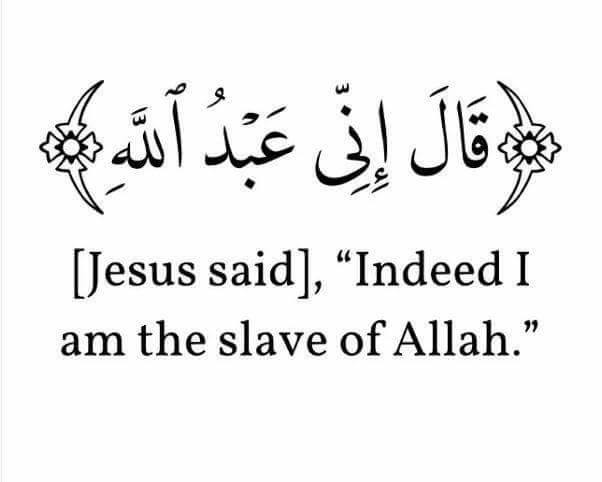
As a born and raised Aramaic speaker, it is likely that Jesus never spoke anything in Biblical Greek or Latin languages, and possibly not even in Hebrew. The Arabic language of Qur’an is closer to the sister language of Aramaic that Jesus actually spoke. It is highly possible that Jesus did make such a statement in Aramaic, and the Qur’an is simply relaying that same message to an Arabic speaking audience.
Therefore, the statement attributed to Jesus in the Qur’an (Indeed I am the slave/servant of Allah) is more plausible than Jesus saying “I am God” or anything similar in Greek or Latin or even Hebrew.
 Blogging Theology
BTW, could you be so kind and tell us how old was Jesus when he said this? 😉
LikeLike
speaking from the cradle –
taken from apocryphal and Gnostic infancy gospels
the author of the Qur’an did not have enough discernment to recognize true Scriptures vs. false Scriptures
LikeLike
Quran is the true revelation from Allah. Throwing allegations that Quran “took” from Apocryphal sources is not substantiated. Quran stands by itself. Jesus spoke in the cradle with no doubt.
Second, Christians have not had clear criteria why some gospels are classified as true and others as apocryphal. What you classify today as apocryphal was canonized according to some of your church fathers.
Dr Ehrman kept asking why christians don’t classify gospel of Peter, for example, as ” true scripture” for it has main outlines of others gospels. No answer so far.
LikeLike
@Ken Temple:
You mean like Jude did not diiscern that Enoch and the assumption of Moses were not true scripture? Or Paul when he quoted the Jannes and Jambres incident?
Perhaps you don’t realise that the cannon agreed in the fourth century after many disputes did not fall from heaven nor did Jesus or any of the disciples agree that the canon is the 27 books?
Some of your canonical books were the apocrypha of other Christians. And the canon of other Christians is your apocrypha.
LikeLiked by 1 person
Lol ouch!
LikeLike
“Behold, My servant will act wisely so as to accomplish the goal; He will be high and lifted up and greatly exalted.”
Isaiah 52:13
his appearance was marred beyond recognition . . . Isaiah 52:14 (sufferings of the cross)
verse 15
he will sprinkle many nations
“for that which has not been told to them they will see and what they have not heard, they will understand.”
[quoted by the apostle Paul in Romans 15:20-21 about the gospel going to all nations who have not heard yet.]
Isaiah 53:1-12
verse 5 – he was pierced for our transgressions, he was crushed for our iniquities” = substitutionary atonement
verse 6 – “the Lord has caused the iniquity of us all to fall on Him” ( taking our sin voluntarily on the cross; being the substitutionary sacrifice)
verse 8 – “he was cut off from the land of the living” = he died – see also Daniel 9:26 – he, the Messiah the Prince will be cut off and have nothing (died).
verse 10 – “it pleased the LORD to crush Him, if he would voluntarily render himself as a guilt offering”
yes, Jesus the Messiah was the suffering servant of God the Father, Yahweh
LikeLike
” yes, Jesus the Messiah was the suffering servant of God the Father, Yahweh”
“Jesus cannot be Yahweh. In Isaiah 44:24 it says that Yahweh was alone when he created the heavens and the earth. Matthew 12:18 quotes Isaiah 42:1 which says that Yahweh will send his servant. Who is that servant? It is Jesus.
Now if Yahweh was the one true God (Exodus 20:2-3) who alone created the heavens and the earth and he was the one who was to send his servant (Jesus), then that means that Jesus is not Yahweh. This means that Jesus is not God.” Bassam Zawadi.
LikeLike
Paul’s use of that Qur’anic verse – Surah 19:30 – that verse is of doubtful historical reality. There is nothing to commend itself historically that Jesus spoke from the cradle – a book that comes 600 years later using a false and Gnostic source from 300-400 years earlier demonstrates the lack of historical truth.
LikeLike
Abdullah
JEsus is not yahweh. He is the word of yahweh.
According to the quran jesus is god’s spirit breathed into human flesh – not a creation unless you somehow think that allah’s spirit is not divine a uncreated. LOL.
Also, jesus is the messiah according to allah – what is the signiicance of that according to the men who concocted the quran?
LikeLike
Abdullah
“Now if Yahweh was the one true God (Exodus 20:2-3) who alone created the heavens and the earth and he was the one who was to send his servant (Jesus), then that means that Jesus is not Yahweh. This means that Jesus is not God.”
False dichotomy and an embarrassing non-sequitur.
God alone does not in any way refute god’s triune nature. And being god’s servant sent by the father does not refute god’s triunity.
The reasoning is terrible in your argument.
LikeLike
Cont…
Just to make it clear – being the sent servant of god does not mean that jesus is not divine. Non-sequitur.
Logical failure…..
LikeLike
“According to the quran jesus is god’s spirit breathed into human flesh – not a creation unless you somehow think that allah’s spirit is not divine a uncreated. LOL.”
This is simply an ignorance of Quranic terminology.
The problem is not much about these titles and terms rather it’s with your heart which is soaked with polytheism.
LikeLike
abdullah
“This is simply an ignorance of Quranic terminology.
The problem is not much about these titles and terms rather it’s with your heart which is soaked with polytheism.”
I believe in one god. You believe in a god whose spirit is finite.
The terminology is clear – jesus is god’s spirit breathed into human flesh. It would take all kinds of logical back-flips to change the meaning of that.
LikeLiked by 1 person
Jesus Al Masih said,
“The Son of Man did not come to be served, but to serve and to give His life a ransom for many.”
Mark 10:45
ransom – same root word used for translating the Greek word in Mark 10:45, that is in the Qur’an 37:107
“we have ransomed him with a mighty sacrifice”
The sacrifice of Abraham’s son pointed to and was a prophesy of the Messiah Jesus. (Genesis 22)
LikeLike
Jesus Al Masih عیسی المسیح in Mark 10:45, is claiming He is the suffering servant of Isaiah 52:13-15 and 53:1-12.
LikeLike
Luke deletes this verse – presumably he disagreed with it.
LikeLike
Another thing – you use lots of memes that quote from either Hadith or the Qur’an, but don’t give the reference. Especially when Hadith is quoted in Memes – no reference, no book, no. , paragraph, chapter, etc.
LikeLike
I’m sure you can look them up. You quite tons of bible verses and rarely quote them in full.
LikeLike
At least I always give the reference so people can look them up. Yours are harder to find when you don’t give the reference.
LikeLike
People don’t want to spend ages looking up all your references Ken. It’s tedious.
LikeLike
Not as tedious as no reference at all. Your quotes are even harder and more tedious to find, especially Hadith quotes. They may not even be in the 6 canonical Hadith collections, and could be considered by Islamic scholars as “weak” Hadith.
LikeLike
Ken stop whinging.
LikeLike
I have a logical point.
LikeLike
Unless you claim to know what Luke was thinking, to say he deletes this saying because he disagreed with it is laughable since you can’t have your cake and eat it too. Do you believe Luke knew and traveled with Paul? Yes or no?
LikeLiked by 1 person
it’s called Redaction Criticism.
LikeLike
But why would Luke, who was on Paul’s missionary team, delete something that agrees with Paul’s theology?
Sam is right.
Just because The Gospel of Luke does not have the verse or pericope, does not mean he “deleted” it.
Matthew has it. (Matthew 20:28)
So, all three are working off of some other common source, if they are doing that at minimum (from a human perspective), that Luke uses for other parts of Mark and Matthew, but does not have that particular passage.
Or all three are independently inspired by God to write what they wrote, and not excluding possibility of the use of prior traditions, sources.
LikeLike
Luke did use multiple sources as you can get from the first page of Luke.
How come he had a different perspective from Paul. Firstly you are assuming that he was in fact a student of Paul. But in any case, he could have different perspective because the earliest followers of Jesus such as James had a different perspective than Paul. You get this from both historical extra-Biblical sources as well as the Bible itself. See Acts 21 when James insists Paul publicly perform an act according to the ceremonial law and the following chapters when neither James nor any of the believers come to Paul’s aid.
Perhaps “Luke” whoever he was, happened to be well acquainted with a non-Pauline salvation message as part of the many sources he mentions in chapter1.
LikeLike
see full and detailed explanation of Luke-Acts with Paul and consistency.
https://apologeticsandagape.wordpress.com/2016/10/07/answering-questions-about-acts-2117-26/
LikeLike
“We are Abraham’s descendants,” they answered. “We have never been slaves to anyone. How can You say we will be set free?” Jesus replied, “Truly, truly, I tell you, everyone who sins is a slave to sin.”
Thus the reason he came and bled and died and was raised from the dead–to atone for my sins, which are numerous. That is the central theme of the N.T. Being a slave to another will not last forever. Dying in our sins without receiving by faith Christ’s sacrifice will have never ending consequences.
Here God promises that he has a plan to redeem us despite the catastrophic events that had just taken place.
And I will put enmity between you and the woman, and between your seed and her Seed; He shall bruise your head, and you shall bruise His heel
LikeLike
You mean like Jude did not diiscern that Enoch and the assumption of Moses were not true scripture? Or Paul when he quoted the Jannes and Jambres incident?
@Fawaz –
Use of historical information in a non-canonical book does not mean the whole book is God-breathed. Jude and Paul are just saying those specific incidents are true; without affirming the entire book where the information is recorded.
LikeLike
There are no credible scholars on jesus’ life who would support the authenticity of this statement. None would agree that jesus said these words.
LOL
LikeLike
Why not? and who would you consider to be ‘credible’ scholars?
LikeLike
PAtrice
Well, NT scholars, of course. Do you know of any who agree that jesus said these words?
LikeLike
Vague…do you know of any NT scholars who agree with you?
LikeLike
Patrice
I don’t know of any who say that jesus said these words. Ehrman, Dunn, Craig, Wallace, Crossan – the list goes on. None of them – as far as I know – have ever agreed that jesus said these words.
Do you know of any NT scholars who take this quranic claim and find it historical?
LikeLike
Since they haven’t addressed it how can you be so sure what they believe about it? You have acknowledged that you don’t know. So where is the root of this confidence?
I like you have never come across a NT scholar address this text hence i am asking you.
LikeLike
PAtrice
I can’t think of a single reason why any credible NT scholars have never addressed the claims made about jesus in manuscripts written 600 years after jesus lived.
Can you think of any reasons why the claims made about jesus that were written in the quran 600 after the events took place would not be addressed by credible NT scholars?
LikeLike
Graham,
You said, “I can’t think of a single reason why any credible NT scholars have never addressed the claims made about jesus in manuscripts written 600 years after jesus lived.”
Here is a single reason: Credible NT scholars are not simultaneously credible Qur’anic scholars, therefore they do not make irresponsible assumptions about something they have no expertise in.
Which is more than we can say for you.
LikeLiked by 1 person
Ibn Issam
The quran makes claims about the historical jesus. This is not a secret.
It makes sense, therefore, that credible scholars of jesus’ life might address the claims made in the quran. As far as I know, no credible scholar includes even the earliest quranic manuscripts in their studies of the historical jesus.
Why do you think this might be? The quran makes several assertions about the historical jesus, but NT scholars ignore it.
LikeLike
I will address this point in a separate article shortly.
LikeLike
Ooooo…..
LikeLike
Graham,
I think that NT scholars don’t have to comment directly on the matter. All of their work indirectly confirms the view of the historical Jesus as portrayed in the Qur’an.
LikeLike
Ibn Issam
Okay. What details of jesus’ life does the quran reveal? For example, when does the quran say jesus was born? WHo was the roman governor at the time? WHere does the quran say that israel was even ruled y the romans?
LikeLike
Graham,
The Qur’an doesn’t need to provide superfluous information to meet your demands, since it correctly presumes that you already have the basic information, and it is more concerned with relating the main points and setting the record straight on the more important matters. You already have the basic story, but the Qur’an is telling you THE story.
BTW the Bible doesn’t mention the exact date of Jesus Birth, will you now stop celebrating Christmas every December 25?
In answer to your question about NT scholars and Qur’an, PW has posted a good answer and explanation here:
https://bloggingtheology.net/2016/11/07/23768/
LikeLike
Graham,
Another reason the Qur’an does not relate certain details of Jesus life, or the Roman Governor, Roman Occupation etc. is because these are really MINOR details in relation to the overall salvific message as conveyed by the Qur’an. The Qur’an redirects our focus towards God, and how we can achieve salvation through belief in Tawhid, obedience to his commandments, and Tawbah (repentance) when we make mistakes, there is no distraction from this core message.
In other words, of course it is good to have an understanding of historical facts, but in the end analysis, we don’t need to know, for example, who the Roman Governor was at the time of Jesus, in order to achieve salvation through Islam.
Alhamdulillah this is a blessing, for Allah has illumined the straight path with clear guidance in the Qur’an.
LikeLike
Graham,
As a born and raised Aramaic speaker, it is likely that Jesus never spoke anything in Biblical Greek or Latin languages, and possibly not even in Hebrew. The Arabic language of Qur’an is closer to the sister language of Aramaic that Jesus actually spoke. It is highly possible that Jesus did make such a statement in Aramaic, and the Qur’an is simply relaying that same message to an Arabic speaking audience.
Therefore, the statement attributed to Jesus in the Qur’an (Indeed I am the slave/servant of Allah) is more plausible than Jesus saying “I am God” or anything similar in Greek or Latin or even Hebrew.
LikeLike
That is one of the dumbest arguments I have ever heard.
Regardless, this doesn’t explain why credible NT scholars don’t address quranic materials in their studies of the historical jesus.
LikeLike
It is no “dumber” than many of the arguments I have seen from you and your friends against Qur’an and Islam.
LikeLike
In answer to your question about NT scholars and Qur’an, PW has posted a good answer and explanation here:
https://bloggingtheology.net/2016/11/07/23768/
LikeLike