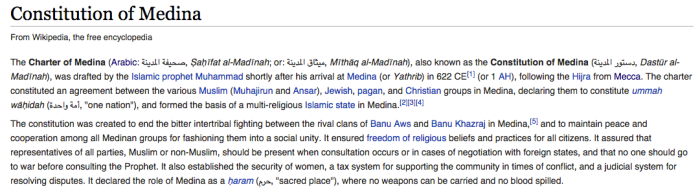
Many Muslims today forget that the original ummah at Medina consisted of Muslims, Jews, pagans, and Christian groups. Typically, Muslims, in my experience, think of the ummah as constituted by Muslims alone. Likewise, non-Muslims today often forget that Muhammad, as chief of Medina, presided over a multi-faith, pluralist state, with guaranteed freedom of religion for all. ISIS rejects everything the Constitution of Medina stands for. Click screenshot for the full article.
Categories: Islam
 Blogging Theology
Interesting, but I still think it still depends upon the context in which the word ummah is used, for instance: It is related by Hazrat Thauban, (Allah be pleased with him) that our Prophet (Sallallaho Alaihe Wassallam) said, “In my Ummah there shall be born thirty liars; each of them will pretend that he is a prophet but I am the last of the prophets; there shall be no prophet after me.” (Abu Dawood, Vol. 2, p.228;Tirmizi, Vol. 2, p. 45).I http://www.anwar-e-khatam-e-nobuwwat.com/index.php/sample-page/khatm-e-nobuwwat-in-the-light-of-ahadith/
LikeLike
good point
LikeLike
The constitution of Medinah is far more authentic than later hadith collections.
LikeLike
But later, Muhammad and the Muslims slaughtered the Banu Qurayza Jews of Medina – after the “Battle of the Trench”. (beheaded 400-900 men; different sources say different numbers) and enslaved the women and children.
Martin Lings, Muhammad: His Life Based on the Earliest Sources, p. 229-233.
From the Wikipedia article:
Ibn Ishaq describes the killing of the Banu Qurayza men as follows:
“ Then they surrendered, and the apostle confined them in Medina in the quarter of d. al-Harith, a woman of B. al-Najjar. Then the apostle went out to the market of Medina (which is still its market today) and dug trenches in it. Then he sent for them and struck off their heads in those trenches as they were brought out to him in batches. Among them was the enemy of Allah Huyayy b. Akhtab and Ka`b b. Asad their chief. There were 600 or 700 in all, though some put the figure as high as 800 or 900. As they were being taken out in batches to the apostle they asked Ka`b what he thought would be done with them. He replied, ‘Will you never understand? Don’t you see that the summoner never stops and those who are taken away do not return? By Allah it is death!’ This went on until the apostle made an end of them. Huyayy was brought out wearing a flowered robe in which he had made holes about the size of the finger-tips in every part so that it should not be taken from him as spoil, with his hands bound to his neck by a rope. When he saw the apostle he said, ‘By God, I do not blame myself for opposing you, but he who forsakes God will be forsaken.’ Then he went to the men and said, ‘God’s command is right. A book and a decree, and massacre have been written against the Sons of Israel.’ Then he sat down and his head was struck off.[46][47][59]
And later, Omar expelled all Christians and Jews from all of Arabia.
How do you explain that?
Hadith from Sahih Muslim:
(21)Chapter: Expulsion of Jews and Christians from the Arabian Peninsula
(21) باب إِخْرَاجِ الْيَهُودِ وَالنَّصَارَى مِنْ جَزِيرَةِ الْعَرَبِ
It has been narrated by ‘Umar b. al-Khattib that he heard the Messenger of Allah (ﷺ) say:
I will expel the Jews and Christians from the Arabian Peninsula and will not leave any but Muslim.
وَحَدَّثَنِي زُهَيْرُ بْنُ حَرْبٍ، حَدَّثَنَا الضَّحَّاكُ بْنُ مَخْلَدٍ، عَنِ ابْنِ جُرَيْجٍ، ح وَحَدَّثَنِي مُحَمَّدُ بْنُ رَافِعٍ، – وَاللَّفْظُ لَهُ – حَدَّثَنَا عَبْدُ الرَّزَّاقِ، أَخْبَرَنَا ابْنُ جُرَيْجٍ، أَخْبَرَنِي أَبُو الزُّبَيْرِ، أَنَّهُ سَمِعَ جَابِرَ بْنَ عَبْدِ اللَّهِ، يَقُولُ أَخْبَرَنِي عُمَرُ بْنُ الْخَطَّابِ، أَنَّهُ سَمِعَ رَسُولَ اللَّهِ صلى الله عليه وسلم يَقُولُ “ لأُخْرِجَنَّ الْيَهُودَ وَالنَّصَارَى مِنْ جَزِيرَةِ الْعَرَبِ حَتَّى لاَ أَدَعَ إِلاَّ مُسْلِمًا ” .
Reference : Sahih Muslim 1767 a
In-book reference : Book 32, Hadith 75
USC-MSA web (English) reference : Book 19, Hadith 4366
LikeLike
Ken
the Banu Qurayza, during the time that Medina was under attack from the massive forces from Mecca, treacherously sided with the enemy and conspired to overthrow the ummah from within. However, the Meccans were defeated (by the grace of God) and the Banu Qurayza were held to account for their treason. They agreed to accept the judgement of an elder who pronounced that all the male combatants be executed.
This is all detailed in Ibn Ishaq’s narrative, which of course you leave out because you seek to make Muhammad look as bad as possible. In so doing you sin again God Ken who commanded you in Exodus 20:16 “You shall not give false testimony”
Treason committed during war is a very serious crime and merits the death penalty in the USA as well.
LikeLike
Fred Donner has some interesting observations on this: The sira depicts a neat
progression of Jewish enmity over the course of Muhammad’s lifetime and
increasingly harsh treatment of them by Muhammad, culminating in the massacre of
the Banu Qurayza. But the “Constitution of Medina,” while it notes that Jews of
various clans were part of umma, doesn’t mention the clans of Nadir, Qaynuqa, and
Qurayza, which according to the rest of the sira were the three most important
Jewish clans of Medina. Why are they not in the “Constitution?” Was reference to
them expunged after their exile or massacre? Or are they merely a literary fiction of
the sira, a confection of later times, created to show the prophet being “prophetlike”
and vanquishing his enemies? It is curious that no trace of the Qurayza massacre
can be found in medieval Jewish tradition—even though the women and children of
Qurayza are described as surviving to be sold into slavery, and could likely have
been able to pass the story on in later years…It is worth remembering, however,
that the Qur‘an itself is almost completely devoid of guidance on politics; it focuses
tightly on the moral demands that each individual in its audience must face. This Qur’anic
silence on matters political means that Islamic political thought—including
the use of Jews as negative examples—is almost completely a product of the sira and
tradition literature, that is, of the eighth and later centuries CE. Many of the stories
(about Khaybar’s Jews for example, or the “no two religions in Arabia” tradition)
have the ring of having been designed precisely to delineate a political world where
Jews (and Christians) were more separated from Muslims than had originally been
the case; but the fact that ahl al-kitab have a protected status in the shari‘a seems to
reflect an older situation. The tradition “no two religions in Arabia” also seems, to
me, likely to be of late date with its emphasis on “the Arabs,” not a concept really
found in Qur’an.
Click to access Donner%20Response%20to%20Nirenberg%20Final.pdf
LikeLiked by 1 person
Umar Ibn al-Khattab (may Allah be pleased with him) relocated the Jewish tribes of Khaybar and Fadak and sent them to Tayma and Ariha. These two regions are considered part of the Arabian Peninsula, but still the Jewish tribes were allowed to settle there.
The scholars of hadith understood what Umar did to mean that the Jews and the Christians are not allowed in the region of al-Hijaz surrounding Makkah and Madinah.
Imam Ibn Hajar al-Asqalani maintains that:
“The pagans are not allowed to settle specifically in the Hijaz region, meaning Makkah, Madinah, al-Yamamah, and their environs. It does not apply to other regions that are considered part of the Arabian Peninsula. This is because everyone is agreed that they may live in Yemen, though it is part of the Arabian Peninsula. This is the opinion of the majority of scholars. (Fath al-Bari 6/198)
LikeLiked by 2 people