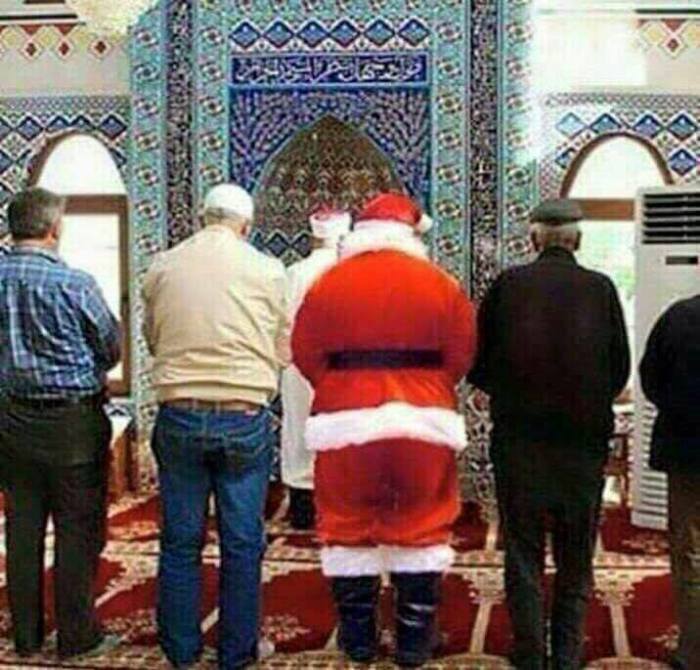
A hard-working Santa takes a few minutes off to nip down to his local mosque, the Aziziye in Stoke Newington, for the prayer.
Categories: Miscellaneous
A hard-working Santa takes a few minutes off to nip down to his local mosque, the Aziziye in Stoke Newington, for the prayer.
Categories: Miscellaneous
 Blogging Theology
“Santa is now Muslim”
He should be, he is from middle eastern origin, he is an Arab 😉
LikeLiked by 1 person
I thought he was Turkish…
LikeLike
He cant be, he had a beard…
LikeLike
But dat curly moustache tho… Türk zindabad 😂
LikeLike
Nickolas the bishop of Myra in the early 300s, was a bishop at the Council of Nicea in 325 AD. At that time, the Turks did not live in what is today called Turkey. It was Greek – Byzantine back then. (Asia Minor, Lycia)
The Seljuk Turks conquered the east of Anatolia / Armenia beginning in 1071 AD. (Aggressive unjust Islamic Jihads)
and the Ottoman Turks conquered the rest of Anatolia slowly over 3 centuries, after that period, and eventually, Constantinople in 1453. (all based on the aggressive and unjust command to conquer the people of the book in Surah 9:29)
So, Nickolas was not a Turk or Arab. Nothing wrong with that, if he was; just trying to be accurate historically.
The historical Saint Nicholas, as known from strict history: He was born at Patara, Lycia in Asia Minor (now Turkey). In his youth he made a pilgrimage to Egypt and the Palestine area. Shortly after his return he became Bishop of Myra and was later cast into prison during the persecution of Diocletian. (303 AD to 311 AD) He was released after the accession of Constantine and was present at the Council of Nicaea in 325 AD.
In 1087, Italian merchants took his body from Myra, bringing it to Bari in Italy. (to escape the invasions by the Turks)
LikeLike
Welcome back Ken. Did you have a good Christmas?
LikeLike
Ken,
Your characterization of the conquest of Anatolia and Constantinople as being a one sided unjust religious aggression by Islam is naïve, misleading and disingenuous. Most importantly, it ignores other historical factors, outside of religion which may have motivated the actions of both the Seljuk and later Ottoman state.
The Byzantine Empire had been at an almost continuous state of war with the Persian Empire with whom the Seljuk’s had aligned themselves with. The Seljuk’s were simply engaged in an ongoing war with the Byzantines that had been in effect for a very long time. By the 1440’s the Byzantine Empire had been reduced to a shadow of its former self. It had been beleaguered by constant raids from Seljuks, and other tribal marauders, along with wars and the costs of administrating a crumbling Empire. By the time of the Ottomans, Byzantium was virtually defenseless and had been reduced to an Ottoman vassal state. But Byzantium was not a loyal vassal and had gathered a coalition of Christian states and launched a crusade against the Ottomans. The Crusade almost destroyed the Ottomans but it was ultimately crushed at the battle of Varna in 1444 by Mehmet’s father Sultan Murad II, whom the Byzantines had also betrayed previously by supporting a pretender to the Ottoman throne, which had also caused a civil war. So it can be seen that the Byzantines had entered into a political relationship with the Ottomans, but had treacherously betrayed that pact. The Byzantine betrayal, and constant plotting threatened the Ottoman’s western boundaries, which required a defensive response from Sultan Mehmet Fetih. This ultimately resulted in the conquest of Constantinople 1453. The subsequent “Counter-Crusade” into Europe was then clearly in recompense to the initial Christian crusade of Varna against the Ottomans, who needed to secure their Northwestern boundary and guard it from further Christian assault. Therefore, as you can see the Turkish actions were not simply motivated “Purely by religion” as you and some others would like people to think, but also by the same concerns that any modern country takes into account, rational political concerns, internal and external threats, and national defense.
It would be more accurate to say that the Christian Crusades were purely motivated by a violent form of Christianity, since it was the Pope himself who called for the invasion of the Arab heartlands and heartless wholesale slaughter of its innocent inhabitants both Muslim and Jew. However, I am sure any honest historian might mention that there were other factors involved such as the failure of feudalism, poverty, a dearth of economic opportunity and lack upward mobility, and an exploding population, among other things. But you don’t grant the same measured analysis of the Ottomans, who were actually waging a “Counter-Crusade” in response to initial western aggression as well as in response to Byzantine political betrayals, treachery, and the Crusade of Varna which was aimed at destroying the Ottomans. Instead of honestly taking these things into account you offer the simple soundbite answer that you and your fans like to hear, “It’s all because of Islam” or “Jihad” etc. As if that’s supposed to explain everything in the complicated tangle of history. I think that Christians are ashamed of their own violent and bloody history, and therefore feel the need to portray Muslim history as being just as aggressive and violent as their own in order to equal the playing field. But it seems that the Christians were the initial agitators as usual.
Just a little historical balance from Christians would be nice once in a while.
LikeLike
Ken states: “The Seljuk Turks conquered the east of Anatolia / Armenia beginning in 1071 AD. (Aggressive unjust Islamic Jihads)”
Ken the seljuks were nomadic warrior tribes. It was their business to raid and settle in new favourably territory regardless of their religious affiliation. You think nomadic turks would’ve refrained from attacking byzantium as non-muslims?
Lol, check the hunnic, alanic, and mongol invasions in that case.
LikeLike
Poiterfrance,
That is a very good point!!
LikeLike
Yes, thank you.
LikeLike
so looking forward to 2017 what kind of articles do you want to see on Blogging Theology?
LikeLike
so looking forward to 2017 what kind of articles do you want to see on Blogging Theology?
Good question. I will need to think more about that.
LikeLiked by 1 person
“What kind of articles do you want to see on Blogging Theology?”
Maybe about how his prophet Paul & the church fathers were more than ok for the “democracy” that pagan romans spread over the world.
LikeLike
Thank you Ken
LikeLike